

 MacKenzie Tyler
 May 28, 2026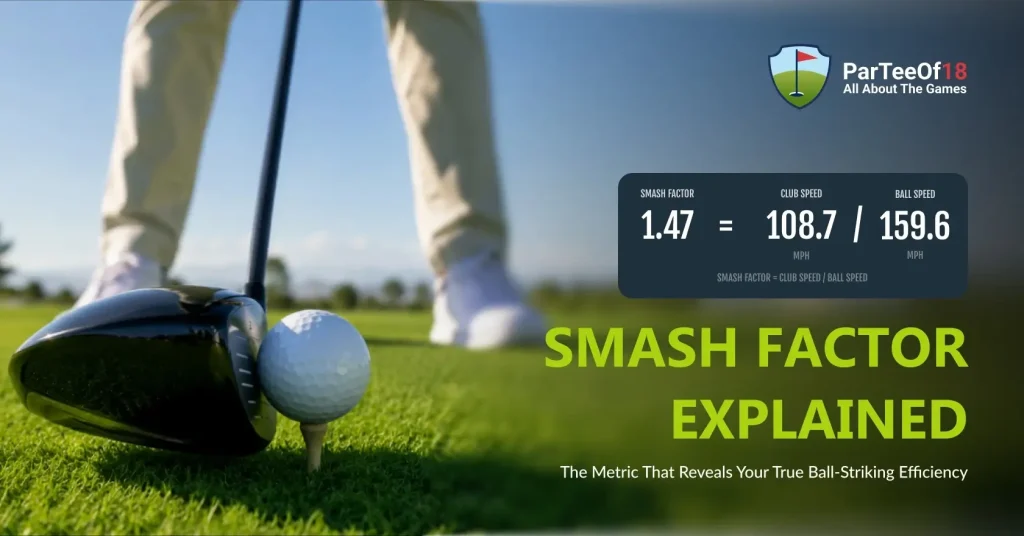
 Last Updated: July 3, 2026


Most golfers obsess over swing speed. They watch tour pros swing at 120 mph and assume that raw power is the only factor. But there’s a number that tells a far more honest story about your ball-striking: smash factor.
Whether you’re a beginner trying to squeeze more yards out of every swing or a mid-handicapper wondering why your driver distance stalls, understanding the smash factor can be a genuine turning point. It explains why two golfers with the same swing speed hit it completely different distances and, more importantly, what you can actually do about it.
What Is Smash Factor in Golf?
Smash factor is a measure of how efficiently you transfer energy from your club to the golf ball. Think of it as the “conversion rate” of your swing, how much of your effort actually ends up as ball speed.
At its core, it answers a simple question: for every mile per hour of clubhead speed you generate, you achieve a corresponding amount of ball speed in return. A higher number means less energy is being wasted and more is going into the ball. A lower number indicates a slower impact speed, whether that’s an off-center strike, an open clubface, or a poor angle of attack.
The Formula and How It’s Calculated
The smash factor calculation is as simple as it gets in golf:
Smash Factor = Ball Speed ÷ Clubhead Speed
Example: If your clubhead speed is 100 mph and your ball speed coming off the clubface is 145 mph, your smash factor is 1.45, which any modern launch monitor will give you instantly.
The USGA Cap and Why It Exists
The USGA and The R&A jointly regulate equipment standards, and one such regulation directly limits the smash factor. Under their rules, drivers are capped at a smash factor of 1.5. This ceiling exists to prevent equipment manufacturers from engineering clubs that simply launch the ball too fast, essentially turning the driver into a slingshot that makes distance a product of engineering rather than skill.
This cap applies to equipment, not to the golfer. What it means in practice is that if you swing your driver at 100 mph, the maximum ball speed a legal driver can produce is 150 mph. The closer you get to that ceiling, the more efficiently you’re striking the ball.
What is a Good Smash Factor?
Here’s the honest answer: it depends on the club. The driver naturally produces the highest smash factors because it’s the longest, lowest-lofted club in the bag. Shorter irons with more loft inherently create more glancing contact, which reduces smash factor, and that’s completely by design.
Here’s a general benchmark table for each club:
| Club | Target Smash Factor (Amateur) | Tour Average |
|---|---|---|
| Driver | 1.45 – 1.50 | ~1.49 – 1.50 |
| 3-Wood | 1.40 – 1.48 | ~1.47 – 1.48 |
| 5-Iron | 1.35 – 1.42 | ~1.39 – 1.41 |
| 7-Iron | 1.30 – 1.38 | ~1.33 – 1.35 |
| Pitching Wedge | 1.20 – 1.28 | ~1.23 – 1.25 |
If you’re consistently hitting 1.45+ with your driver, your ball-striking efficiency is genuinely good. A driver that goes less than 1.35 is a clear sign that you’re leaving yards on the table at every tee box.
Smash Factor Benchmarks: Tour Averages vs. Amateurs
Seeing the numbers side by side makes the efficiency gap between pros and amateurs very clear.
PGA Tour: The average driver smash factor on the PGA Tour sits right around 1.49, with ball speeds in the 170–185 mph range off swings of 113–120 mph. These players are nearly maxing out the USGA ceiling on almost every drive.
LPGA Tour: LPGA players’ average driver smash factors are in the 1.46–1.48 range, routinely matching or slightly trailing PGA Tour numbers. Here’s the genuinely interesting part when it comes to irons, LPGA Tour players often match or exceed PGA Tour smash factor averages. Because their swing speeds are lower, they’ve developed exceptional strike precision to compensate, and it shows in their iron efficiency numbers.
Average Amateur: Somewhere in the 1.35–1.42 range with the driver. Most recreational golfers with a 14–15 handicap are swinging around 93–95 mph but getting ball speeds well short of what their speed could produce, simply due to strike inconsistency.
The Rory Standard: Rory McIlroy has reportedly produced smash factor readings as high as 1.537 in testing environments technically above the USGA’s 1.5 equipment limit, but those measurements were taken under specific conditions during swing studies. It is often cited as a standard for elite, centered, full-speed contact when everything aligns perfectly.
The gap between a 1.35 and a 1.48 smash factor at 95 mph swing speed works out to about 12 mph of ball speed, which translates to roughly 25–30 yards of carry. Few changes in golf can create that kind of distance gain as quickly as centered contact. The quality of the strike is crucial.
What Affects Your Smash Factor?
Smash factor golf isn’t just about swinging harder; it is a reflection of how efficiently energy transfers from the club to the ball at impact. A few key elements can influence how solid and consistent that number really is.
Centeredness of Strike
The most significant factor in your golf swing is striking the ball accurately. If you hit the ball even a half-inch off-center, it can drop your smash factor by 0.05 or more. Every driver and iron has a “sweet spot,” which is the exact point on the clubface where maximum energy transfer occurs. Modern clubs with larger faces and perimeter weighting are more forgiving of mis-hits, but they can’t fully compensate for poor contact. To determine where you think you are, consider using a foot spray or impact tape to find out where you’re actually hitting the ball.
Face Angle Relative to Club Path
An open or closed clubface at impact not only produces a curved shot but also wastes energy. When the face isn’t square to the path, a portion of the contact energy goes into creating side spin rather than forward ball speed. Even a 5-degree open face will measurably lower your smash factor because you’re effectively hitting across the ball rather than through it.
Angle of Attack
When using a driver, adopting a slightly upward angle of attack (positive AoA) generally helps the smash factor by reducing spin and promoting a cleaner, more efficient impact. For irons, a slightly descending strike is normal and optimal. Getting your angle of attack wildly outside normal ranges, either extremely steep with the driver or extremely shallow with irons, tends to produce glancing contact that significantly reduces your smash factor.
Club Head Speed
While swing speed itself doesn’t directly improve your smash factor ratio, it does interact with it. Golfers with higher swing speeds tend to have more consistent mechanics, which produce more consistent strike locations. Simply trying to swing harder without those mechanics usually lowers smash factor, as it sacrifices strike quality for raw speed.
Equipment Fit
A shaft that’s too stiff for your swing speed means the club never loads and releases properly through impact. A driver head that’s poorly matched to your natural ball flight can create compensatory moves that move contact off-center. Getting properly fitted doesn’t just help with launch conditions; it also removes the equipment variables that quietly drag down smash factor.
How to Improve Your Smash Factor
Small changes in technique and contact can make a noticeable difference, helping you achieve greater efficiency, cleaner strikes, and stronger overall performance.
Improve Strike Location
This is the highest-ROI change most recreational golfers can make. Spend a session with foot spray or impact tape on your clubface and just observe your natural strike pattern. Many golfers are surprised to discover consistent toe or heel misses. Once you know where contact is happening, you can experiment with small setup tweaks (ball position, stance width, distance from the ball) to move it toward the center.
Don’t Swing Harder – Swing Better
The most important thing to understand is that harder swings rarely improve the smash factor. Focusing solely on increasing raw clubhead speed can often result in mishits and a loss of distance. It’s important to optimize your swing mechanics to achieve the ideal 1.50 smash factor. You can achieve this by making centered contact, maintaining a square face at impact, and creating an ascending angle. Hitting the ball outside the sweet spot significantly reduces energy transfer and ball speed.
A helpful drill is to swing with about 80% effort, aiming for a sharp “crack” on impact rather than a dull thud. That distinct sound indicates that your contact was clean.
Get a Proper Fitting
A fitting session with a qualified club fitter that uses a launch monitor involves more than just determining the right loft or shaft flex. A good fitter will watch your smash factor numbers in real time across several clubs and configurations. It’s common for golfers to walk out of a fitting having gained 8–10 mph of ball speed simply by switching to an appropriate shaft, not because their swing changed, but because the equipment stopped fighting them.
The #1 Misconception: Harder Swings = Better Smash Factor
This misconception deserves its own section because it is so pervasive and counterproductive.
When golfers see their distance drop, the instinct is often to swing harder. However, in smash factor golf, it doesn’t consider how hard you try; it only considers where the clubface contacts the ball and how square that contact is. Swinging harder while striking the heel at 108 mph produces far less ball speed than making clean, centered contact at 102 mph.
There’s a reason why even long-drive competitors who swing at 140+ mph obsess over their smash factor. Adding speed while losing efficiency is a neutral move at best. But adding speed and maintaining smash factor is when the real distance gains happen.
The practical takeaway: if your goal is more distance, chase centeredness before you chase speed. Understanding this distinction separates golfers who actually improve from those who wear out their shoulders trying to swing harder every spring.
Conclusion
Smash factor golf is the number that reveals whether your swing is actually working for you or against you. It’s calculated simply by ball speed divided by clubhead speed, but what it tells you is profound: how much of your athletic effort is becoming forward momentum on the ball and how much is just noise.
The USGA caps it at 1.5 for a reason; the tour pros are close to that ceiling, and most recreational golfers are 0.10 to 0.15 below their potential. That gap isn’t filled by working out, buying a new driver, or trying to swing like a tour player. It’s filled by learning where you strike the ball and then methodically improving it.
If you want to genuinely get better at golf, tracking the right metrics matters. Tools like ParTeeOf18’s handicap estimator can help you understand where your game stands overall, and when you combine that with a focused look at ball-striking efficiency, improvement stops being abstract and starts being measurable.
Start Your Smarter Golf Journey Today!


FAQs
Does the type of golf ball affect smash factor?
Yes, but less than most golfers think. Premium urethane-cover balls are optimized for energy transfer and can marginally increase ball speed compared to Surlyn-covered two-piece balls. However, the effect is typically small but measurable ball speed differences compared to the impact of strike quality. Fix the strike first, then optimize the ball.
Can your smash factor ever be too high for irons?
Not practically speaking, but context matters. Irons with very strong lofts (modern “game improvement” irons often have 7-iron lofts of 30 degrees or less) will naturally produce higher smash factors because they behave more like fairway metals. If your smash factor with a 7-iron is unusually high, it might mean your iron lofts have been bent too strongly, or you’re playing a club that’s really functioning as a different club than its number suggests.
Why is my smash factor lower with irons than my driver – is that normal?
Yes, it is completely normal and expected. As club loft increases, smash factor inherently decreases because the contact becomes more glancing. A typical 7-iron smash factor of 1.30 is perfectly healthy, whereas a 1.30 with a driver would indicate a real ball-striking problem.
How do I measure my smash factor without a launch monitor?
You can’t calculate it precisely without measured data. However, many golf retailers offer free launch monitor sessions, and portable units like the Garmin Approach R10 or Rapsodo MLM2Pro have made in-range data much more accessible. Impact tape and foot spray remain the low-tech way to address the centeredness issue often reflected in the smash factor.
Will swinging a heavier or lighter shaft improve my smash factor?
It can, if the current shaft is seriously mismatched to your swing. A shaft that’s too heavy may cause you to decelerate through impact; one that’s too light may create timing issues that move contact off-center. The goal is a shaft that allows your natural swing to produce consistent, on-center strikes, and that’s different for every golfer.
Is smash factor the same as COR (Coefficient of Restitution)?
Related, but not the same. COR is a property of the clubface that measures how springy it is, essentially, how much the face deflects and rebounds at impact. The USGA sets a maximum COR of 0.83. Smash factor is the on-course result that COR contributes to, but it’s also influenced by strike location, face angle, and swing dynamics. High COR enables a high smash factor but doesn’t guarantee it.
All Premium Features Unlocked
No catch. Cancel anytime




MacKenzie Tyler is a competitive golfer preparing to turn professional on the LPGA Tour. A former All-League golfer and three-sport athlete, Tyler spent nine seasons caddying at Sebonack Golf Club on Long Island, where she developed a thorough understanding of the game. In 2025, she won the Long Island Amateur at -4 over 36 holes, qualified for the U.S. Mid-Amateur, and became the first alternate at her U.S. Women's Open qualifying site after leading the field through round one.


Related Posts

9 Fun Golf Putting Games to Play (Practice Green and On the Course)
Discover fun golf putting games for the practice green and real rounds, plus the drills that back them up and...

What Is a Chip Shot in Golf? How to Hit It and When to Use It
Learn what a chip shot is, when to chip vs. pitch vs. putt, and how to hit it clean. Simple...

What Is Lag Putting? (And the 3 Drills That Actually Fix It)
Learn what lag putting means, why distance control matters, and three practical drills to help reduce three-putts and improve your...

What Is PCC in Golf? Playing Conditions Calculation Explained
PCC is the daily adjustment that corrects your score differential when a course plays easier or harder than its rating....