

 MacKenzie Tyler
 November 25, 2025
 Last Updated: August 4, 2026


Ever stood on the first tee, watching someone casually say they’re a “12 handicap,” and thought, what does that even mean? Golf has its own language, and nothing sparks more confusion (or quiet intimidation) than that little number players love to throw around.
That’s where things get interesting. Because what is a handicap in golf isn’t just some random stat, it’s determined for fair competition. It’s the reason a weekend warrior can go toe-to-toe with a seasoned club regular and actually have a shot. Sounds a bit strange, right?
Still, ask around, and you’ll hear mixed answers. Some think it’s a score. Others believe it’s a badge of honor. And plenty are still scratching their heads, wondering what handicap means in golf and why it matters so much on the course.
Here’s the truth; once that number clicks, the entire game changes. Matches make sense. Strategy sharpens. And suddenly, every swing carries a little more weight and a lot more thrill.
What is a Handicap in Golf?
A golf handicap is a numerical measure of a player’s potential ability which is used to level the playing field so that golfers with different skill levels can compete fairly. It represents the number of strokes a player can subtract from their gross score, to level the playing field, with a lower handicap indicating a more skilled player, who is expected to score close or at par on a typical course.
Categories of Golf Handicaps
While the USGA doesn’t officially “label” golfers, the community generally categorizes players into three tiers based on their Handicap Index, which dictates their consistency and the complexity of the golf shots they can reliably execute.
| Category | Handicap Index | Skill Profile |
|---|---|---|
| Low Handicap | 0 to 9 | Often called “single-digit” players; they possess high consistency and can break 80 regularly. |
| Mid Handicap | 10 to 19 | The largest group of regular golfers, strikes the ball well but struggles with occasional inconsistency and short-game errors. |
| High Handicap | 20+ | Beginners or casual players who focus on basic contact, may struggle to break 90 or 100. |
Note: If your index is exactly 0.0, you are considered a Scratch Golfer, meaning you are expected to play to par on any rated course. If your index is lower than zero (indicated with a plus sign, e.g., +2.0), you are a Plus Handicapper and actually have to add strokes to your score.
Types of Handicap in Golf
Golf handicaps, structured under the World Handicap System (WHS), allow players of varying abilities to compete equally. While the terms are often used interchangeably, each serves a specific purpose in translating your skill level to a fair score on a particular day. Understanding the distinction between these three types is the key to distinguishing a fair match from a scoring dispute.
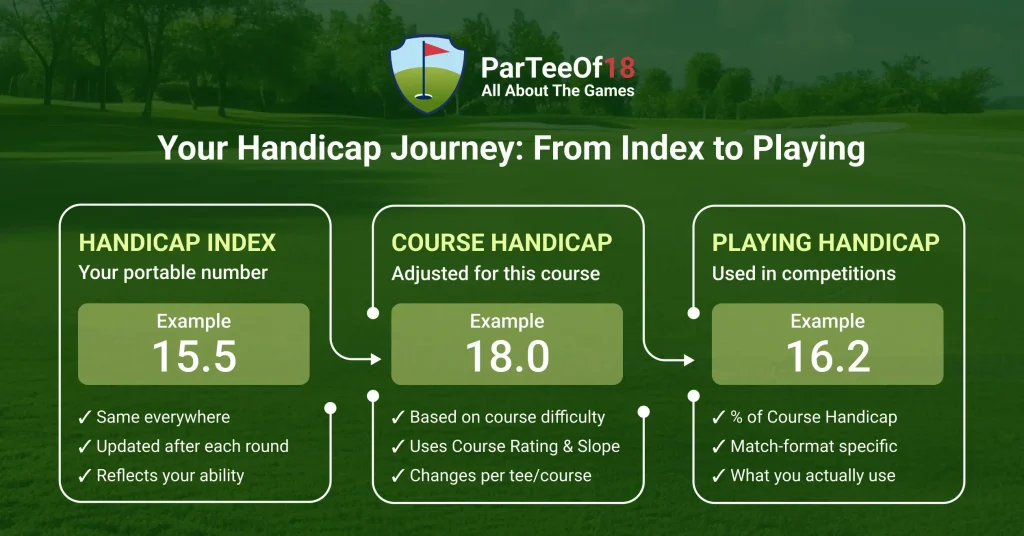
Handicap Index
This is a portable number that represents your demonstrated potential. It is calculated to one decimal place (e.g., 12.4) and follows you from course to course. It serves as the baseline standard of your ability, independent of where you play, with a maximum index of 54.0.
Course Handicap
This number adjusts your Handicap Index to reflect the difficulty of the specific course and tees you are playing. Since some courses are harder than others, the Slope Rating, and Course Rating are used to determine how many strokes you need relative to the difficulty of that course.
Golf Playing Handicap
This is the final number of strokes a player receives or gives during a specific round, or a competition. It is calculated by applying a Handicap Allowance to your Course Handicap based on the format of play (e.g., 95% for individual stroke play or 85% for four-ball). This ensures equity depending on how the game is being scored.
7 Things to Know About Golf Handicap
To master the WHS, you have to look past the definitions and understand how these variables actively affect your index. Here are the seven mechanics that dictate whether your handicap trends up, down, or stays stagnant.
Acceptable & Unacceptable Scores
Not every round counts. To affect your handicap, a score must be played on a course with an official Rating/Slope and during an active season from authorized formats (individual/four-ball stroke/match play). Generally, you must play at least 9 holes and follow the Rules of Golf (including having a marker). Casual mulligan rounds or solo play often don’t count, meaning they won’t lower or raise your Index.
Maximum Hole Score
The WHS prevents a single “disaster hole” from destroying your handicap via Net Double Bogey. If you take a 10 on a par-4 where you get a stroke, the system records it as a 7 (Par + 2 + handicap strokes received {1 stroke}) for handicap purposes. This cap ensures your index reflects your standard skill level rather than your worst nightmare, preventing your handicap from escalating because of a single outlier.
Target Score
Under the WHS, your target score is what you need to shoot to play to your handicap. It is now calculated as Course Rating + Course Handicap. If you shoot this number, you have successfully demonstrated your potential for that round. Consistently playing below this score will cause your Handicap Index to drop.
Handicap Allowance
Used primarily in competitions (like a Four-Ball or Scramble), an allowance that reduces your Course Handicap by a percentage (e.g., 85% or 95%). While this allowance determines your “Net” score for the tournament leaderboard, it does not change your lifetime Handicap Index or the Score Differential recorded in your history. Your Handicap Index is updated based on your Adjusted Gross Score (actual strokes played, capped at Net Double Bogey), regardless of what allowance was used in the event.
Stroke Index
The Stroke Index (SI) ranks the holes on a course from 1 to 18 based on where a player needs strokes most. It dictates where you apply your handicap. If you have a Course Handicap of 10, you get one extra stroke on the holes ranked SI 1 through 10, which helps save your score on the hardest parts of the course.
Course Rating
The Course Rating is the system’s estimate of what a scratch golfer (0 handicap) would play. It acts as the anchor point for your score; if you shoot an 85 on a course with a rating of 72.0, your score differential for that day is essentially 13. A higher course rating makes it easier to achieve a lower differential.
Slope Rating
The Slope Rating (ranging from 55 to 155) measures how much harder a course is for a bogey golfer compared to a scratch golfer. It acts as a multiplier for your Index; the higher the slope, the more strokes you receive. This ensures that a 15-handicapper is not penalized for playing a much more difficult course than usual.
How to Calculate Golf Handicap?
Your Handicap Index is built from your best 8 score differentials out of your last 20 rounds, using the Course Rating and Slope Rating printed on your scorecard. For the full formula, a worked example, and the exact step-by-step process, read our complete guide on How to Calculate Golf Handicap.
If you’d rather skip the math, our Free Handicap Estimator pulls the Course and Slope Rating automatically once you pick your course and tees, so all you enter is your score.
5 Common Misunderstandings About Golf Handicaps
Understanding your golf handicap can genuinely change how you experience the game. It’s not just a number; it’s a numerical measure designed to make golf fairer, and more enjoyable. Yet, many players misinterpret how it actually works. Let’s clear up a few common misconceptions, for the next time you step onto the course.
1. It’s Not Your Average Score
A lot of golfers assume their handicap reflects what they typically shoot. That’s not quite right. A proper golf handicap shows your potential, not your consistency.
The system focuses on your better rounds rather than your usual ones. In other words, it answers the question, how well can you play when things click?, and not, what do you normally shoot on an average day?
2. Lower Doesn’t Always Mean Better (In Every Match)
It’s easy to think the player with the lower handicap in golf will always come out on top. But that’s not how the system is designed.
Handicaps are meant to level the field. When adjusted using a golf playing handicap players of different skill levels can compete on equal footing. That’s why a higher-handicap golfer can still win, especially on a good day.
3. Not Every Round Counts the Same
One bad round won’t wreck your progress, and one great round won’t suddenly redefine your game either.
Your golf handicap is calculated using a selection of your best recent scores, not every single round you play. This rolling system keeps things fair, and prevents dramatic swings based on a single outing.
4. Course Difficulty Matters More Than You Think
Not all golf courses are created equal and the system accounts for that.
When calculating your handicap in golf, factors like course rating, and slope rating come into play. That means shooting the same score on two different courses can have very different impacts. A tougher course can make a higher score more valuable in your handicap calculation.
5. It’s Not Just for Competitive Golfers
There’s a common belief that handicaps are only for tournament players. That couldn’t be further from the truth.
Whether you’re new to the game or just playing casually with friends, having a golf handicap adds purpose to your rounds. It helps you to measure improvement, set goals and enjoy more balanced matches, no matter your skill level.
Also Checkout: Handicap Index vs Course Handicap: Key Differences Explained
How Can You Get an Official Handicap?
To get an official Handicap Index, you need to join a USGA-authorized golf club, get a GHIN number, and post scores from at least 54 holes. For the complete four-step process, eligibility rules, and mistakes to avoid, read our full guide on How to Get a Golf Handicap Index.
A Quick Note on the World Handicap System
Your handicap runs on the World Handicap System (WHS), the global standard adopted by the USGA and The R&A in 2020 and used by more than 130 national associations. It updates your index daily and caps single bad holes so one blow-up doesn’t wreck your number, whether you play in Charlotte or Scotland. For the full mechanics, including the Best 8 of 20 rule, the Soft Cap and Hard Cap safeguards, and how the system evolved from the old model, read our complete guide on How Does Golf Handicap Work.
Start Your Smarter Golf Journey Today!


FAQs
What is a Net Score?
Your net score is your actual total strokes (gross score) minus your Course Handicap. It essentially reflects how you played relative to your skill level. For instance, if you shoot a 90, and have a 14 course handicap, your net score is 76.
What is a good golf handicap?
A good golf handicap is generally considered to be 10 or lower. An individual with a handicap in this range is a mid-handicapper who consistently shoots in the mid-80s, and is better than the average male golfer (14.0) and female golfer (28.8). A handicap of 9.9, or lower is considered “low,” placing a golfer in the top 25% of all players.
What is the maximum Handicap Index?
Under the World Handicap System (WHS), the maximum Handicap Index is 54.0 for all players, regardless of gender. This was updated in 2020 from lower limits to make the game more inclusive for beginners.
Can my handicap be negative?
Technically, yes, though the golfing world calls these “plus handicaps”. If you are better than a “scratch” golfer (0.0), your index is prefixed with a plus sign (e.g., +2.0). When calculating a net score, you add these strokes to your gross score rather than subtracting them.
How often is my handicap updated?
Your Handicap Index is updated daily under the World Handicap System. The system recalculates it at midnight local time after you post a score, ensuring your index always reflects your most recent demonstrated ability.
Is the Handicap system perfect for everyone?
While it’s the best “equalizer” we have, it isn’t perfect. It is designed to reflect your potential (the average of your 8 best scores out of 20), not your average score. This means you’ll only “play to your handicap” about 20–25% of the time, which can be frustrating for some.
What if a hole is started but not completed?
If you start a hole but pick up (for example, in a match where the hole is conceded), you must record your most likely score for handicap purposes. This score cannot exceed your Net Double Bogey limit for that hole.
What happens when I play only 9 holes of golf?
You can still post it. The WHS allows for 9-hole scores to be combined or scaled to produce an 18-hole Score Differential. As long as you play at least 9 holes, the score will count toward your index calculation.
Why is it important to post scores on the Day of Play?
Posting on the same day allows the system to calculate the Playing Conditions Calculation (PCC). The PCC determines if course conditions (like high winds or tough pin placements) were significantly harder or easier for everyone that day and adjusts your score differential accordingly.
How do players with different handicaps ‘give and get strokes’?
In match play, the higher-handicap player “gets” the difference between the two handicaps. For example, if a 15-handicapper plays a 10-handicapper, the 15-handicapper gets one stroke on each of the five hardest-ranked holes (indicated by the “Stroke Index” on the scorecard).
How Can I Post My Score for Handicap?
To post your score for handicap purposes, log in to your regional golf association’s mobile app, like GHIN, the official web portal, or a digital scoring kiosk. Select the course and the specific tees played, then enter your score either hole-by-hole or as a total adjusted gross score. Ensure you apply the Net Double Bogey limit to any high-scoring holes before submitting. You must post the score on the same day it was played to account for the daily Playing Conditions Calculation.
You can post a score through GHIN.com, the GHIN app, a pro shop kiosk, or an authorized app like ParTeeOf18. For every posting method, the Home vs Away vs Competition rules, and the most common posting mistakes, see our complete GHIN Score Posting guide.
All Premium Features Unlocked
No catch. Cancel anytime




MacKenzie Tyler is a competitive golfer preparing to turn professional on the LPGA Tour. A former All-League golfer and three-sport athlete, Tyler spent nine seasons caddying at Sebonack Golf Club on Long Island, where she developed a thorough understanding of the game. In 2025, she won the Long Island Amateur at -4 over 36 holes, qualified for the U.S. Mid-Amateur, and became the first alternate at her U.S. Women's Open qualifying site after leading the field through round one.


Related Posts

9 Fun Golf Putting Games to Play (Practice Green and On the Course)
Discover fun golf putting games for the practice green and real rounds, plus the drills that back them up and...

What Is a Chip Shot in Golf? How to Hit It and When to Use It
Learn what a chip shot is, when to chip vs. pitch vs. putt, and how to hit it clean. Simple...

What Is Lag Putting? (And the 3 Drills That Actually Fix It)
Learn what lag putting means, why distance control matters, and three practical drills to help reduce three-putts and improve your...

What Is PCC in Golf? Playing Conditions Calculation Explained
PCC is the daily adjustment that corrects your score differential when a course plays easier or harder than its rating....