Golf dots have a funny way of showing up in conversations before anyone explains what they actually are. You’re on the back nine, someone drains a birdie putt, and before the ball even stops rolling, a playing partner calls out, “that’s a dot,” and half the group nods, the other half smiles and says nothing, quietly filing the phrase away for later. If you’ve been on the quiet half of that exchange, you’re not alone.
The dots golf game is a unique side game that is entirely shared through word of mouth. It spreads from one Saturday morning group to another without any official rulebook. This game rewards the moments that truly deserve recognition, such as birdies, impressive recoveries, and the shots that make the rest of the group pause in admiration.
Once you understand how the dot game works, you’ll wonder how you played without it. It layers a side competition onto any round without changing how anyone plays, and it fits whether you’re in a serious stroke play event or a casual nine-hole match play round with friends.
What Are Golf Dots?
Golf dots (also called Junk, Garbage, or Trash) is a side game where players earn or lose points called dots for specific on-course events like birdies, sand saves, scrambles, and three-putts. Each dot carries an agreed cash value, and totals are settled at the end of the round.
The name traces back to how the game was originally tracked with a literal dot marked next to a player’s name on the scorecard each time they earned or lost a point. Before apps and digital scoring, caddies and players kept tally on a paper card, and those small pen marks became the shorthand slang for the whole format. The dots weren’t a metaphor; they were right there on the card, hole by hole and the name was just stuck.
What Earns a Dot in Golf?
In the popular golf betting game Dots, specific on-course achievements and great shots earn a positive dot (+1 point or more for the rare feat) for good golf moments. Groups don’t run every dot on this list at once, they pick which ones count before teeing off (more on that below).
- Hole-in-one / Ace
- Birdie or better
- Eagle
- Net birdie
- Sand save
- Up and down
- GIR (Green in Regulation)
- CTP (Closest to the Pin)
- FIR (Fairway in Regulation)
- Long drive
- Chip-in
- Barky (par after your ball hits a tree)
- Long putt (holed from well outside tap-in range, often longer than the flagstick)
Negative Dots: How They Change Everything
Negative dots add penalty triggers that subtract points from a player’s cumulative total, shifting the game’s risk-reward balance.
- Three-putt
- Penalty stroke
- Lost ball / OB
- Double bogey or worse
- Missed fairway
Dots Is a Layer, Not a Replacement
The Dots golf game is an additional scoring system played concurrently alongside standard stroke play or match play, or tournament formats. It never replaces or interferes with the official rules of golf; you still record your real strokes on the scorecard exactly as you normally would.
Instead, Dots acts as an extra layer of friendly competition by tracking independent points or tokens for specific on-course achievements like great drives, sand saves, or long putts. By rewarding these individual extraordinary shots, the system keeps every player engaged and competitive, even on a bad scoring hole.
5 Things to Agree On Before the Round Starts
Set clear ground rules to keep the dots golf game fun, and free of disagreements. Here’s a quick rundown of why all 5 of your points are important, plus common choices for each.
1. Which Dots Are in Play?
Before starting a round of the golf betting game Dots, your group must explicitly agree on which achievements earn a point.
- Standard Dots: Birdies, sandies (par after being in a bunker), and greenies (closest to the pin on par 3s).
- Junk Dots: Barkies (par after hitting a tree), arnies (par without ever entering the fairway), and polies (making a putt longer than the flagstick).
- Negative Dots: Double bogeys, hitting into the water, or three-putts.
2. How Much Is Each Dot Worth?
Assign a monetary or point value to a single dot.
- Fixed Value: Each dot has a set value, like $1 or $5.
- Tiered Value: Rare dots (e.g., an eagle or a hole-in-one) may be worth double or triple the base amount.
3. Gross or Net Scoring?
Decide how your handicaps affect the game in gross vs net scoring.
- Gross Scoring: Raw scores only, as it benefits lower-handicap players.
- Net Scoring: You get strokes based on your official handicap, which evens the playing field for different skill levels.
4. Who Keeps Score?
Assign one person to track the side bets with the main scorecard.
- The Keeper: Records the dots on a piece of paper, or uses a dedicated golf app.
- Verification: Count the golf dots together at the turn (after hole 9) and on the 18th green.
5. How Does Payout Work?
Clarify how you calculate your final math to avoid confusion at the clubhouse.
- Difference Method: You can subtract your total dots from each other, and pay the difference amount directly to the winners.
- The Pot Method: Everyone chips into a central pool, and dots are paid out like shares from the total pot.
Dots in Action: A Quick Example
Say you and a buddy set the dot value at $1 each, standard dots only, gross scoring. On the front nine, you make two birdies (+2) and a sand save (+1), but you also three-putt once (-1). That puts you at +2 through nine. Your buddy chips in for birdie on the par 5 (+1) and sticks a tee shot close for a greenie (+1), with no negative dots to speak of. That’s +2 for them too. Dead even at the turn.
On the back nine, you hit a tree on 14 and still walk away with par for a barkie (+1), then close out with a long putt outside the flagstick for one more (+1). You finish at +4. Your buddy three-putts twice coming in (-2) and ends the round at +1. At 18, you compare cards: +4 for you, +1 for your buddy. The difference is 3 dots, so your buddy hands over $3.
How Dots Work in ParTeeOf18?
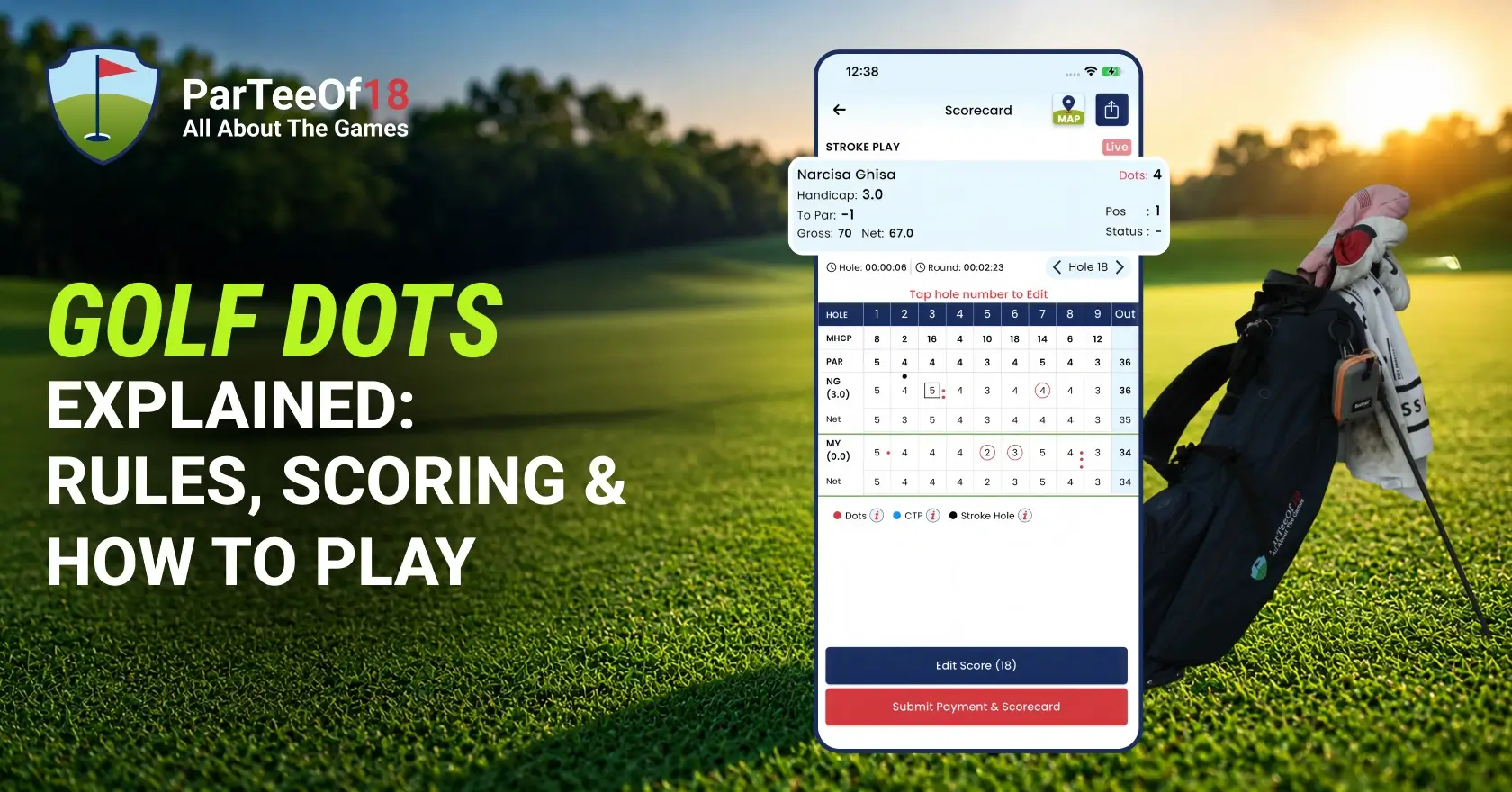
ParTeeOf18 is a USGA Authorized Handicap Data Affiliate golf app where you can turn on a “Dots” side game toggle during round setup. It runs automatically with any golf formats like Stroke Play or Skins, tracks scores and points hole by hole in real time, and settles balances at the end through an in-app wallet.
Setup: Switch the toggle on during round setup alongside your main game format.
Tracking: Scores go into the app hole by hole, and dots update live on group and individual score screens.
Special Rule: In Footie’s Famous (a team format within the app), every player’s dots count on every hole even if their team score does not.
Settlement: The app totals the dots at the end and settles payments through the in-app wallet.
Turn on Dots, We Do the Counting From Tee to Settlement.


Frequently Asked Questions
What are golf dots?
The golf dots game, also known as garbage, junk or trash, is a popular side-betting game where players earn points or dots for specific achievements, and good shots during a round.
How do you play Dots in golf?
You must decide clear point values for unique achievements before teeing off, and mark a physical dot on the scorecard whenever an achievement is earned. Total all the dots after the round to determine the winner and settle the bets.
What is the dot game in golf also called?
The dot game is most commonly referred to as Garbage, Junk or Trash. It acts as a catch-all format to combine multiple individual side bets into a single round.
Can you play golf dots in a scramble?
Yes, groups can contribute dots to the team for birdies and other team achievements. Or you can track individual golf dots on scramble shots such as hitting the longest drive.
Do negative dots make the game fairer?
Yes, negative dots penalize mistakes like three-putts, or hitting trees, which levels the competition against lower-handicap players who would otherwise earn more positive dots by default. Adding negative dots keeps all players accountable regardless of skill level.
How do you settle dots at the end of a round?
To settle the dot game at the end of a round of golf, count up each player’s total accumulated points, and calculate the financial differences between players.




 3D Green Maps
 Handicap Lookup
 Live
Scorecard & Leaderboard
Live
Scorecard & Leaderboard Digital
Wallet
Digital
Wallet Randomizer