 Golf Tips & Education
 MacKenzie Tyler
 September 19, 2025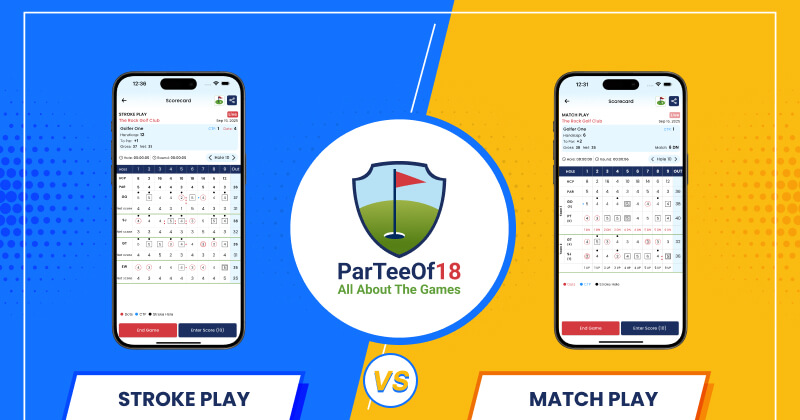
 Last Updated: August 6, 2026


One bad hole. That’s the difference between a wrecked scorecard and a shrug you forget by the next tee box. But how that bad hole feels, and what you do right after it, is where stroke play vs match play stop being two versions of the same game and start being two completely different sports wearing the same clothes.
You probably know the rules already, or close to it. This is about something the rulebook doesn’t tell you: how each format messes with your head, changes the shots you should hit, and rewards a completely different kind of golfer.
Stroke Play vs Match Play: The Scoring Difference at a Glance
| Stroke Play | Match Play | |
|---|---|---|
| Goal | Fewest total strokes over the round | Win more holes than your opponent |
| Holes counted | Every hole, every stroke, added together | Each hole is its own contest, won or halved |
| Score language | “3 under,” “88 gross” | “2-up,” “all square,” “3&2” |
| Penalty impact | Strokes added to your total (compounds) | Loss of the hole only, capped at a 2-hole swing |
| Concessions | Not allowed, every ball holed out | Allowed, opponents can concede putts and holes |
Stroke play is you against the golf course, with every golfer in the field as a silent scoreboard. Match play is you against one person, and the course barely matters once you’re both standing in the fairway. That single difference, total strokes versus holes won, changes almost everything about how you should play. If you’re new to the game, it’s worth understanding the common golf scoring terms used on every scorecard.
Want to dive deeper on the basics?
Checkout: Full Stroke Play rules Or Full Match Play rules.
Pressure, Psychology, and How Each Format Breaks Golfers
This is where match play vs stroke play stop being about scorekeeping mechanics and start being about what’s happening between your ears. Same 18 holes, same clubs, but the two formats tax completely different parts of your brain, and once you feel the difference firsthand, the strategy adjustments later in this piece stop sounding like generic advice and start making obvious sense.
Stroke Play: The Compound Pressure of Every Shot
Say you’re playing a par 4 and you snowman it. Nine strokes. In stroke play, that number doesn’t go away. It sits on your card as a permanent 5-over on one hole, and it drags your whole round down with it. You can play the next 14 holes at even par and still card an 82 because of those nine strokes on number 4. That’s the part beginners underestimate about stroke play: it’s not that one hole beats you, it’s that one hole never lets go.
Match Play: The Reset Button Effect
Now play that same hole in match play. You make the nine, your opponent makes a bogey five. You lose the hole. That’s it. You’re 1-down. The next tee box is a clean slate, same as if you’d both made par. This is the single biggest reason match play feels less brutal to play. A blowup hole costs you exactly one hole, never more, no matter how ugly it gets.
Momentum and Confidence Swings
Momentum works differently in each format too. In stroke play, momentum is mostly internal. You feel it building when you string together pars, and you feel it collapse after one bad swing, but nobody’s actively fighting you for it. In match play, momentum is a resource you’re actively taking from someone else. Win three holes in a row and you can feel your opponent tighten up before they even hit a shot. That’s not superstition. Watching someone’s swing get shorter and quicker when they’re 3-down with 6 to play is one of the more satisfying things in golf, and it’s a dynamic that simply doesn’t exist in stroke play.
How Your Brain Handles the Back Nine Differently
By the back nine of a stroke play round, most golfers are doing math. What do I need to shoot to break 90? Can I afford a bogey on 15? That math is exhausting, and it’s part of why so many good front nines turn into sloppy back nines. In match play, the math is simpler and louder: am I up, down, or square, and how many holes are left. There’s no hiding in a good running total. You know exactly where you stand after every hole, which either steadies you or rattles you depending on how you handle direct confrontation.
In stroke play, one hole can define your whole round. In match play, one hole doesn’t define your next hour.
Playing to Win Each Format: Tactical Differences
None of that pressure and momentum stuff is just interesting trivia. It’s the actual reason smart golfers play stroke play and match play so differently on the same course, sometimes in the same week. Know which format punishes risk and which one rewards it, and the club selection below stops looking random.
Stroke Play Strategy: Limit Damage, Protect Your Score
Good stroke play golfers play boring golf on purpose. From the fairway, a 5-iron to the fat part of the green beats a 3-wood that flirts with a hazard, even when the 3-wood covers 20 more yards, because the 5-iron takes disaster off the table. The whole format rewards playing within yourself: reliable clubs over hero clubs, short game trust over long game ego, and treating bogey as an acceptable outcome instead of a failure. You’re not managing one hole. You’re managing 18 of them and trying to keep the big numbers off the card.
Match Play Strategy: Aggressive Opportunism Wins Holes
Match play flips that logic. If your opponent is in the water, you don’t need to hit a great shot, you need to hit a safe one and let them beat themselves. But if they’re sitting pretty and you’re not, that’s exactly when you pull the driver you’d never hit in stroke play, because the downside of a blown hole is capped and the upside of stealing a hole from a golfer who thought they had it locked up is huge. You’re not playing the course. You’re playing your opponent’s decisions, one hole at a time.
Risk Management: When to Play Safe vs When to Attack
| Play Safe | Play Aggressive | |
|---|---|---|
| Stroke Play | Almost always, protect the round total | Only late, when you’re chasing a number and running out of holes |
| Match Play, 1-down, 3 to play | Only if your opponent is already struggling | Usually, you need holes, not a good scoring average |
| Match Play, 2-up, 3 to play | Usually, make them do something to catch you | Rarely, there’s no reward for extra risk |
The Role of Your Opponent vs the Course
In match play, you’re playing game theory against a person who reacts to what you do. Lay up short and safe when they’re in the rough, because you don’t need the extra risk when their next shot is already the harder one. In stroke play there’s no opponent to read. It’s you against 18 holes and whatever the course throws at you, and the only “opponent” that matters is the version of you that gets impatient on hole 14.
Handicap Application and Why It Matters Differently
Handicap allowance is one of the more overlooked pieces of stroke play vs match play, and it changes the psychology of the round more than most golfers realize. Under the USGA’s Rules of Handicapping, the recommended allowance is 95% in individual stroke play and 100% in singles match play. Small gap on paper. Big difference on the course.
Here’s why it matters. In match play, your strokes land on specific holes based on the stroke index, and you get full credit for them. If you’re a 15-handicapper playing an 8-handicapper, holes 1 through 7 on the stroke index are your stroke holes. Make a gross bogey on one of those and it’s a net par. You just halved a hole you technically lost outright, and there’s zero mental cost to a mediocre swing on that hole. That removes the psychological ceiling stroke play imposes, where every stroke counts the same no matter who you’re playing against.
In stroke play, that same 15-handicapper subtracts their full handicap once, at the very end, from an 18-hole total. There’s no hole-by-hole relief. A double bogey on hole 4 still feels like a double bogey while you’re standing over the next tee shot, even though it’ll get absorbed into the math eventually. That delayed gratification is part of why stroke play feels heavier to play, even for golfers who technically have the same handicap advantage on both formats.
Choose Your Format Based on Your Goal
Play Stroke Play If You’re…
Tracking real progress toward a lower handicap, prepping for a competitive event that uses stroke scoring, or just want an honest measure of how you played 18 holes start to finish. It’s also the format for solo rounds or big fields, since you’re not tied to one opponent’s pace or decisions.
Play Match Play If You’re…
Looking for a faster, more social round with one friend or a small group. A bad front nine won’t wreck your whole day, which makes it a better format for building confidence, and the head-to-head element makes even a casual Saturday round feel like it matters.
Mixed Skill Groups: Which Format Works Better?
If your group has a mix of a 6-handicap and an 18-handicap, match play with full handicap allowances keeps things closer than stroke play ever will. Net matches let the higher handicapper compete hole by hole instead of watching a growing gap on the scorecard all day. Stroke play, especially without careful net scoring, can turn into a rough afternoon for the weaker player fast.
Tournament vs Casual Round: Format Implications
Nearly all four major golf championship, the Masters, the U.S. Open, the PGA Championship, is decided by stroke play, because it’s the fairest way to rank a large field over multiple rounds. Match play shows up more in team events like the Ryder Cup and club-level knockout tournaments, where head-to-head drama is the point. For a weekend foursome, match play usually wins on fun, but plenty of golfers alternate depending on the group and the day.
Format-Specific Rules That Change How You Play
A few rule differences quietly shape the decisions above, and they’re worth knowing cold:
Gimmes exist in match play. Your opponent can concede a short putt to speed up play or make a strategic point, but every ball has to be holed out in stroke play, no exceptions. That alone changes how aggressively you read a 3-footer for bogey when nothing but pride is on the line.
Penalties hit differently too. A rules breach in match play costs you the hole, capped at a two-hole swing on the overall match. In stroke play, most breaches add two strokes directly to your score, and that number compounds with everything else on the card.
Order of play is stricter in match play. If your opponent has the honor, you wait, full stop. Stroke play allows ready golf, so whoever’s ready can hit, which is part of why stroke play rounds can move faster in casual settings even though the format has a reputation for being slower.
And a match can end before the 18th hole. Go 4-up with 3 holes left and the match is over on the spot. Stroke play always plays out the full round, even if the outcome was decided hours ago.
Stroke Play vs Match Play: Which Format Wins Your Game
Neither format is better. They’re built to test different things. Stroke play tests whether you can grind through 18 holes without letting one bad swing snowball. Match play tests whether you can win a fight, hole by hole, against a person standing right next to you.
Play both enough and you’ll notice they make you a better golfer in different ways. Stroke play sharpens patience and course management. Match play sharpens nerve and the ability to shake off a bad hole immediately instead of carrying it.
Track both formats in ParTeeOf18 golf app and see which style actually suits your game. The app scores Stroke play and Match play automatically, with full handicap support built in, so you can spend less time doing math on the 15th tee and more time playing the shot in front of you.
Before your next round, check out our Golf Terms Guide to get familiar with the words and phrases you’ll hear on the course, from scoring terminology to match play expressions.
Score both formats with full handicap support, live leaderboards and scorecards.


You Might Also Like to Checkout some more golf format comparison blogs like:
- Shamble vs Scramble Explained – Which Format Is Better
- Foursomes vs Fourball: What’s the Difference and Which Format Should You Play?
- Best Ball vs Scramble: What’s the Difference and Which Format Should You Play?
FAQs
What happens in a tie after 18 holes in stroke play?
If two or more players tie on total strokes, most tournaments use a sudden-death playoff where the first player to win a hole outright is declared the winner, though some competitions use an aggregate play-off over a set number of holes.
Is Stableford a match play or stroke play?
Stableford is technically classified under stroke play by the Rules of Golf, but it uses a points-based system rather than total strokes. Players score points per hole based on their result relative to par, and the highest points total wins rather than the lowest stroke count. It sits somewhere between the two formats in feel, which is why it often gets its own category in club competition formats.
Which major golf tournaments use match play and which use stroke play?
The Masters, PGA Championship, U.S. Open, and The Open Championship are the four biggest men’s golf tournaments. They all use 72-hole stroke play, which means that the player with the lowest total score wins. Major match play events are rare, with the prestigious Ryder Cup, the Presidents Cup, and a number of amateur championships being the main ones.
Can you play stroke play and match play at the same time?
Officially, no. The Rules of Golf treat them as separate formats with different rule applications, and competitions are run as one or the other. In casual rounds some golfers track both for fun, but this has no official standing and the USGA does not recognise combined formats for handicap or competition purposes.
How do the rules differ in match play vs stroke play?
In match play, you play against an opponent and try to win individual holes, and penalties in this format usually mean losing a hole, and putts can be given up, while in stroke play, you count every stroke over 18 holes, and if you break the rules, you get a 2-stroke penalty.
What is the main difference between stroke play and match play?
The main difference is how the winner is determined. In stroke play, the player with the fewest total strokes across all 18 holes wins. In match play, the player who wins the most individual holes wins, regardless of the total strokes taken. A bad hole costs you one point in match play but can damage an entire round in stroke play.
Which is harder, stroke play or match play?
Stroke play is generally considered harder because every single shot counts toward the final score. There is no recovery from a blow-up hole the way match play allows. Match play is psychologically more intense hole by hole, but the format is more forgiving since one lost hole does not compound across the rest of the round.
All Premium Features Unlocked
No catch. Cancel anytime




MacKenzie Tyler is a competitive golfer preparing to turn professional on the LPGA Tour. A former All-League golfer and three-sport athlete, Tyler spent nine seasons caddying at Sebonack Golf Club on Long Island, where she developed a thorough understanding of the game. In 2025, she won the Long Island Amateur at -4 over 36 holes, qualified for the U.S. Mid-Amateur, and became the first alternate at her U.S. Women's Open qualifying site after leading the field through round one.


Related Posts

Gross vs Net Golf: What Each Score Means and How to Use Both
Gross vs net golf explained simply. Learn what each score means, how to calculate both, and which one counts in...
Handicap Index vs Handicap: What’s the Difference and Why It Matters
Handicap index vs handicap aren't the same. Learn the difference, how course handicap is calculated, and which number to use...
Graphite vs Steel Shafts: Which Is Better for Irons?
“Graphite is only for seniors and beginners.” If you still believe that, you’re missing out on some of the biggest...

Lob Wedge vs Sand Wedge: What’s the Difference and When to Use Each?
Confused about lob wedge vs sand wedge? You’re not alone. Many golfers understand that both clubs can be useful tools,...