
 Golf Tips & Education
 MacKenzie Tyler
 April 9, 2026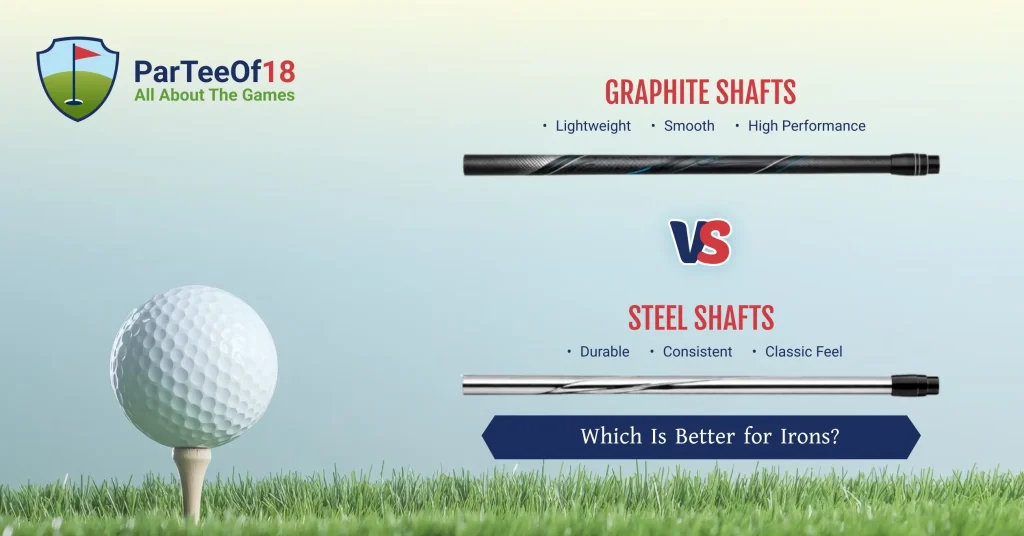
 Last Updated: July 3, 2026


“Graphite is only for seniors and beginners.” If you still believe that, you’re missing out on some of the biggest tech advancements in golf. Modern graphite is winning on Tour, and high-tech steel is getting lighter than ever. The old stereotypes are dead, so when evaluating steel shafts versus graphite shafts, which one actually gives you the best chance to stick it close to the pin?
Read on to explore further into the debate: Graphite vs Steel Shafts: Which Is Better for Irons?
Graphite vs Steel Shafts at a Glance
Each type of iron shaft offers unique benefits in feel, weight, performance, and other features. Below is a quick comparison of steel shafts versus graphite shafts to make the differences easy to understand.
| Feature | Graphite Shaft | Steel Shaft |
|---|---|---|
| Material | Carbon fiber layers & resin | Carbon or stainless steel alloys |
| Weight | Lighter; 40g–115+g | Heavier; 95g–130+g |
| Primary Goal | Distance & swing speed | Accuracy & control |
| Target Swing Speed | <85 mph (with a 7-iron) | >85 mph |
| Feel | Soft & dampened (mute) | Firm & Crisp |
| Shock Absorption | High (easier on joints) | Low (transmits more sting) |
| Torque | Higher, more twisting (3-8°) | Lower, more stability (2-4°) |
| Durability | Prone to scratches | Robust & durable |
| Relative Cost | More expensive and fragile | Budget-friendly |
| Best For | Golfers with slower swing speeds, beginners, seniors, or those with joint pain | Golfers with faster swing speeds, aggressive tempos, or those seeking high consistency |
What are Graphite Shaft Irons?
Graphite shaft irons are golf clubs made from a composite of carbon fiber and epoxy resin, prized for their high flexibility and a weight range that typically spans 40g to 115g.
Within this category, ultralight options (45g–65g) are a prime choice for seniors, juniors, or players with slower tempos looking to maximize distance while minimizing physical fatigue. The broader 45g–95g range bridges the gap between these featherweight designs and standard-weight graphite (65g–95g), which serves as an ideal transition for average-speed swingers moving away from heavier steel.
A common critique of older/traditional graphite designs was their high torque of 3-8° or tendency to twist. However, modern premium graphite is engineered for extreme stability; many high-end models now have a very low torque of 1-3° and match or even outperform the ratings of stiff steel. By combining this newfound precision with superior vibration dampening, these shafts deliver a smooth, joint-friendly feel and an effortless launch.
The history of graphite began in 1969 when Frank Thomas, an engineer at Shakespeare Sporting Goods, developed the first prototype. Though they debuted at the 1970 PGA Merchandise Show, they were initially a luxury item, costing a staggering $500 per pound of material. Throughout the 80s and 90s, manufacturing improvements made them the standard for drivers and woods.
NOTE: Using a 40-65g shaft is generally recommended if you have a slower tempo or struggle with joint pain, whereas heavier options (95g+) are better suited for faster, more aggressive swings.
What are Steel Shaft Irons?
Steel shaft irons are golf clubs whose shafts are made of carbon steel or stainless steel alloys, favored for their heavy weight (95g–130g) and rigid stability. Traditionally designed for better golfers with faster swing speeds, these shafts offer a firm, communicative “feel” and lower torque of 2-4°, which helps maintain maximum accuracy and control by resisting twisting during the swing.
The journey of steel began as a hollow-tube alternative to hickory wood in the late 1890s, though it wasn’t officially legalized for tournament play by the USGA until 1924. Early designs were often too heavy or stiff, but the game changed in 1929, followed by the R&A, when True Temper perfected the “step-down” manufacturing process, allowing for consistent flex across every club in a set. By the time Billy Burke won the 1931 U.S. Open with an all-steel bag, the era of wooden shafts was effectively over, by cementing steel as the gold standard for precision and durability for nearly a century.
Also Checkout: Forged vs Cast Irons: Which Is Right for Your Game?
Steel Shafts versus Graphite Shafts: Key Differences
Choosing between steel vs graphite shafts involves several factors, from weight and flexibility to control and cost. Each characteristic can influence your game in different ways. Below is a detailed comparison of their key differences to guide your understanding.
Weight
The most immediate distinction when comparing a graphite vs steel shaft is the physical heft. A steel shaft is naturally much denser, weighing between 95g and 130g, which helps golfers maintain a steady, rhythmic tempo. On the other hand, graphite shaft irons offer a featherlight alternative, with composites weighing as little as 40g and 115g, allowing for a much lighter overall club feel. Ultralight options (45g–65g) are a prime choice for seniors or juniors looking to maximize speed, while standard-weight graphite (65g–95g) serves as an ideal bridge for those transitioning away from heavier steel.
Flexibility and Torque
Flexibility dictates how a steel shafts versus graphite shafts club “loads” during the swing. Steel is inherently rigid and resists twisting, favored by those with aggressive transitions. Conversely, graphite can be engineered with a specific “whip” to help smoother tempos generate more kick. While traditional graphite was once prone to excessive twisting, modern premium graphite is engineered for extreme stability; many high-end models now match or even outperform the low-torque ratings of stiff steel.
Vibration Dampening
One of the biggest wins for steel vs graphite irons in the comfort department is how they handle impact. Steel is a great conductor of energy, meaning miss-hits can send a stinging vibration straight to your hands. Graphite acts like a shock absorber; its composite fibers soak up that harsh feedback, making it the preferred choice for anyone dealing with golfer’s joint pain or arthritis.
Shot Trajectory
The ball flight often changes depending on whether you use a steel shaft vs graphite shaft irons. Because graphite is lighter and easier to swing fast, it generally helps players launch the ball higher into the air with more spin. Steel shaft tends to produce a more penetrating, lower trajectory, which is often favored by high-speed players who want to keep the ball from bouncing in the wind.
Control and Accuracy
For many purists the debate between steel shafts versus graphite shafts ends with precision. The heavy, low-torque nature of steel makes it incredibly stable, meaning the clubhead is less likely to twist on off-center hits. While modern graphite has significantly closed the gap, steel is still widely regarded as the standard for shot shaping and dispersion patterns.
Swing Speed
If you are looking to find extra yards, graphite vs steel shaft irons are designed specifically to help. The reduced weight of carbon fiber allows you to move the club faster with the same amount of effort, often resulting in an immediate bump in clubhead speed. Steel requires more physical strength to move at the same velocity, which is why it’s usually paired with naturally fast swingers.
Cost
Finally, your budget will likely play a role in choosing graphite or steel irons. Steel is significantly more affordable to manufacture and remains the budget-friendly standard for most iron sets. Because the production of high-quality carbon fiber is a complex, multi-layered process, graphite shafts usually come with a higher price tag or a premium upcharge (about $25-$100+ more per club).
Also Checkout: Cavity Back vs Blade Irons: What’s the Difference?
Advantages of Graphite Shaft Irons
Graphite iron shafts have been designed as high-performance substitutes to steel shafts, with player health and performance improvements being the key considerations in their development. The feature is lightweight carbon fiber that helps players reduce shaft weight by up to 50 grams per club, increasing clubhead speed and enabling players to add 5 to 10 yards to carry distance.
Besides giving players additional power on the swing, graphite materials have a built-in anisotropic property, allowing players to enjoy custom-made stability similar to that of professional players. These materials also help absorb vibrations, acting as shock absorbers and reducing the “sting” players experience when making a bad hit.
Advantages of Steel Shaft Irons
For the golfer who wants accurate shots and value, the steel iron shaft is considered an ideal choice in the market because of its stability. The low torque helps prevent the club head from twisting at high speeds. In addition, this shaft assures that the club face remains square at impact, thereby enhancing dispersion and distance.
Moreover, steel offers intact transparency, meaning the golfer can easily determine the exact spot on the club face that made contact with the ball. In terms of durability, these shafts do not rust and remain robust even with extensive use on the ground.
The Stigma Around Graphite Iron Shafts
For a long time, there’s been a common myth that choosing these lighter shafts is a sign of a “weak” or “aging” game, largely because early versions were often too flexible and marketed strictly to seniors or beginners. The “old man club” myth suggested that better players needed the 120g–130g mass of traditional steel to maintain a steady tempo and prevent the clubhead from twisting.
However, that stigma is quickly fading as modern engineering has produced high-performance anisotropic composites that are just as stiff and heavy as metal, but with way better feel, even leading top-tier pros to make the switch for the sake of their joints and overall swing speed. Today, graphite has finally conquered the iron market with advanced composites now providing the same steel-like stability without the physical toll on the golfer.
You May Also Checkout: 3 Wood vs 5 Wood: Which Fairway Wood Do You Need?
Who Should Use Steel Shaft vs Graphite Shaft Irons?
electing the shaft iron between steel shafts versus graphite shafts largely depends on individual swing speed and level of experience. A graphite shaft is the ideal choice for individuals with a slow swing speed especially senior players, beginners, and women because a lighter shaft can add 5 to 10 yards of distance. Also, graphite shafts are highly recommended for individuals with joint pain, as they offer better vibration damping.
Modern premium graphite, once reserved for beginners, is now sophisticated enough that even low-handicappers can enjoy these physical benefits without sacrificing the stability once exclusive to steel. On the other hand, Steel shafts remain the gold standard for high-speed, “aggressive” swingers who prioritize pinpoint accuracy and a heavy, stable feel. The increased weight entitles players to keep their rhythm constant, as well as provide accurate control of distance.
Start Your Smarter Golf Journey Today!


FAQs
Are graphite shafts better than steel shafts?
Neither is objectively better, but they serve different needs. Graphite is superior for vibration damping and increasing swing speed due to its light weight, making it ideal for players seeking distance or joint relief. Steel offers more feedback and consistency which helps players with high swing speeds and controls their ball flight.
Do pros use steel or graphite shafts for irons?
The vast majority of Tour pros use steel shafts for irons because they prioritize precision and a heavy, stable feel. However, more pro players like Bryson DeChambeau and Rickie Fowler are switching to high-end, tour-grade graphite shafts to reduce physical strain without sacrificing control.
What is the lifespan of a graphite shaft?
A graphite shaft can last for a lifetime or decades and often exceed 10-20+ years, if properly maintained. Unlike steel, graphite doesn’t rust or fatigue over time, as long as the outer laminate isn’t cracked, gouged, or delaminated from impact, it will retain its original flex and performance indefinitely.
Do you swing slower with graphite shafts?
Actually, most golfers swing faster with graphite. Because graphite is significantly 30-50 grams lighter than steel, it reduces the overall static weight of the club, allowing for an increase in clubhead speed. If a player swings slower with graphite, it’s usually because the shaft is poorly fitted or feels “too light” to time correctly.
All Premium Features Unlocked
No catch. Cancel anytime




MacKenzie Tyler is a competitive golfer preparing to turn professional on the LPGA Tour. A former All-League golfer and three-sport athlete, Tyler spent nine seasons caddying at Sebonack Golf Club on Long Island, where she developed a thorough understanding of the game. In 2025, she won the Long Island Amateur at -4 over 36 holes, qualified for the U.S. Mid-Amateur, and became the first alternate at her U.S. Women's Open qualifying site after leading the field through round one.


Related Posts

Gross vs Net Golf: What Each Score Means and How to Use Both
Gross vs net golf explained simply. Learn what each score means, how to calculate both, and which one counts in...

Handicap Index vs Handicap: What’s the Difference and Why It Matters
Handicap index vs handicap aren't the same. Learn the difference, how course handicap is calculated, and which number to use...

Lob Wedge vs Sand Wedge: What’s the Difference and When to Use Each?
Confused about lob wedge vs sand wedge? You’re not alone. Many golfers understand that both clubs can be useful tools,...
Cavity Back vs Blade Irons: What’s the Difference?
Choosing the right irons can make a bigger difference in your golf game than most players realize. One of the...