
The Randomizer

A powerful pairing system designed to create fair, flexible, and intelligent golf groups, from small member events to 100+ player outings.
The Power of Our Randomizer

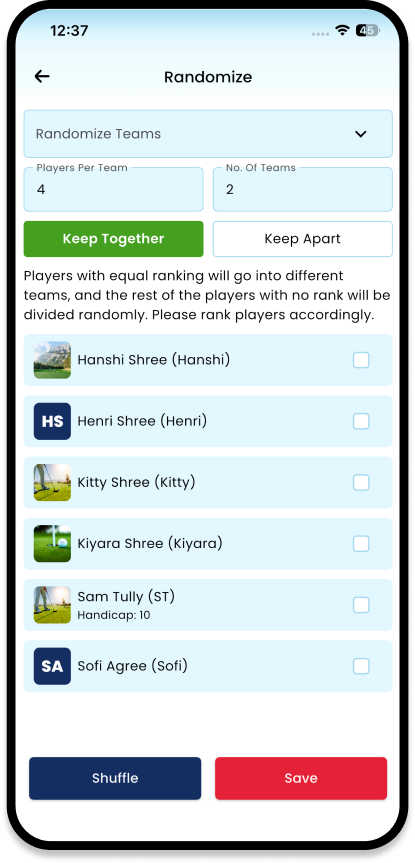
Our Randomizer isn’t just a feature, it’s a system designed to handle real‑world golf logistics at scale. Whether you’re managing a 12‑player member event or a 120‑player corporate outing, the Randomizer ensures fair, flexible, and efficient group creation.
shot

Creating Pairings

For events where player names are entered manually or uploaded via spreadsheet, automatic pairing is the most efficient solution.

Automatic Pairing by Entry Order

This method is ideal for large outings with 100+ players.

How it works:

  1. Players are entered in starting‑hole order.
  2. The system pairs players automatically based on entry number.
  3. Groups are filled sequentially, typically into foursomes.

Why it’s powerful:

  1. Eliminates manual work for large fields.
  2. Ensures fast, consistent group creation.
  3. Perfect for shotgun starts and large corporate events.

  • If a player is accidentally skipped or a spreadsheet contains a threesome, the system will continue filling groups sequentially.
  • This may result in the final group becoming a threesome.

To fix this:

  • Identify where the missing player should have been.
  • Add the missing player (or a placeholder).
  • Assign them the same entry number as another player in that foursome.
  • Re‑run pairings by entry number.
This flexibility ensures mistakes don’t require starting over.

For member events, leagues, and competitive tournaments, groups can be created using multiple intelligent methods:

1. Random Pairing

  • Completely unbiased
  • Ideal for fun events, scrambles, and casual competitions

2. Manual Pairing

  • Full control over who plays together
  • Useful when:
    • Teammates must be grouped
    • Certain players need specific tee times
    • League rules require consistency

Example: Thursday Night League where teammates must stay together but tee times vary.

3. Handicap‑Based Pairing

  • Players are grouped according to handicap
  • Commonly used for individual stroke‑play events
  • Helps balance competition

The AB method divides the field into two skill‑based categories.

How it works:

  • Lower half of handicaps = A players
  • Upper half of handicaps = B players
  • Groups are formed by pairing strongest with weakest

Example (12 players):

  • A Players: 1–6 (lowest handicaps)
  • B Players: 7–12 (highest handicaps)

Pairings:

  • Player 1 plays with Player 12
  • Player 2 plays with Player 11
  • Player 3 plays with Player 10

This ensures competitive balance across groups.

The ABCD method adds even more balance by breaking players into four skill tiers.

Example: 12‑Player Field

  • A Players (lowest handicaps): 1, 2, 3
  • B Players: 4, 5, 6
  • C Players: 7, 8, 9
  • D Players (highest handicaps): 10, 11, 12

Resulting Teams

  • Team 1: 1 (A), 6 (B), 7 (C), 12 (D)
  • Team 2: 2 (A), 5 (B), 8 (C), 11 (D)
  • Team 3: 3 (A), 4 (B), 9 (C), 10 (D)

Each group receives an even distribution of skill, creating fair and competitive play.

Some pairing challenges go beyond a single round — and this is where the Randomizer’s flexibility truly shines.

Multi‑Round Golf Trips

  • Players should avoid playing with the same partners every day
  • Requires rule‑based pairing selections
  • Groups can still be adjusted manually via tee‑time menus

Seasonal & League Play

Example: Thursday Night League

  • Over multiple rounds, players should rotate through different group combinations
  • Traditionally requires manually reviewing previous tee sheets
  • The Randomizer lays the groundwork for tracking and reducing repeat pairings across an entire season

Each group receives an even distribution of skill, creating fair and competitive play.

Why This Matters

The Randomizer is built around real golf operations — not theory.

It understands:

  1. Large‑scale event logistics
  2. Competitive balance
  3. Human error and last‑minute changes
  4. The need for both automation and manual control

This is what makes it powerful — not just for the app, but for how golf events are actually run.