

There’s a moment on every par 4 where you’re standing on the tee box, driver in hand, and your mind is doing something most golfers never actually talk about, and you’re not just trying to hit the fairway; you’re trying to figure out which part of it gives you the best shot into the green. The left side opens up the flag; the right side leaves you blocked by that front bunker. It’s a decision that happens in about three seconds, and it quietly determines everything that follows.
That’s what the fairway in golf actually is, and not just the mowed strip of grass between the tee and the green, but a strategic lane with a right answer on every hole. Understanding what counts as a fairway, why landing in it (and specifically where in it) changes your entire round, and how to consistently put the ball there off the tee is the difference between scrambling for bogey and actually giving yourself birdie looks. This blog post breaks it all down.
What Is a Fairway in Golf?
The fairway is the closely mown strip of grass between the tee box and the putting green on a hole. It’s the target landing area for your tee shot, and the short grass gives you a clean lie and a clear path to the green.
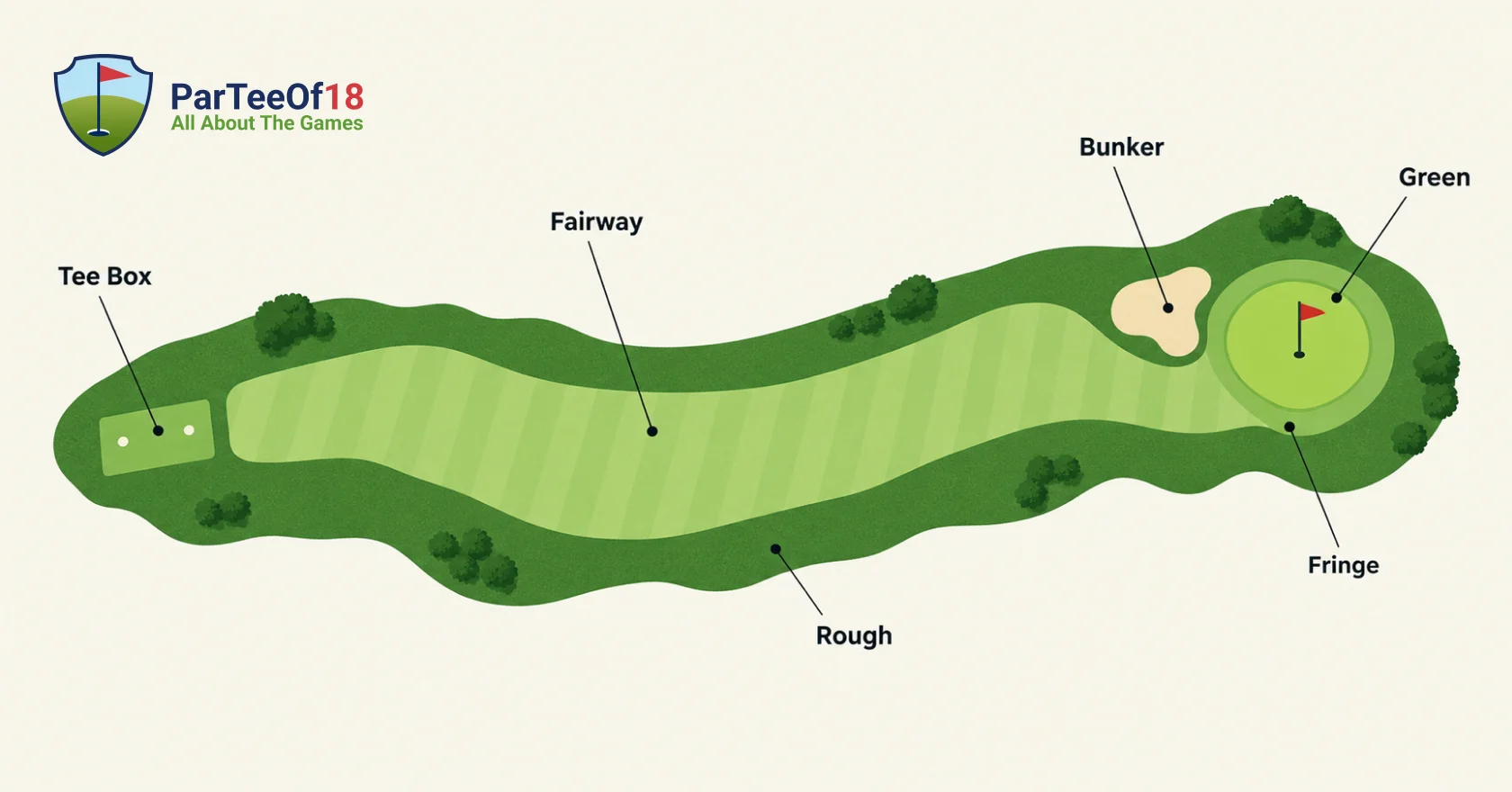
Think of a golf hole like a long highway where you want to stay in the center lane. The golf fairway is that smooth, short-cut center lane. Because the grass on the fairway is cut very short and even, it provides an ideal surface to hit your next shot. When your ball lands here, it is easy to find, sits up nicely on top of the grass, and allows your club to make clean contact with the ball.
If you miss this target area, your ball will likely land in the rough, the longer, thicker grass bordering the fairway, making your next shot much more difficult.
Fairway vs Rough: What’s Actually Different?
The main difference between a golf fairway vs rough is the height and thickness of the grass, which directly changes how the ball sits, how the club interacts and how the ball flies. Here’s what separates the two:
The Fairway
The golf fairway features grass cut very short, usually between half an inch and three-quarters of an inch. This smooth surface lets your ball sit cleanly on top of the turf, and helps the ball roll farther after it lands. You get a clean connection between your club and the ball, which gives you maximum distance and accurate control for your next shot.
The Rough
The rough surrounds the fairway with grass that grows significantly taller, and denser. When your ball lands here, it often sinks down into the blades. The thick grass wraps around your clubhead during your swing. This resistance slows the club and cuts spin, so the ball comes out with less predictable distance and spin. Sometimes it flies farther and runs out, sometimes it dies short.
Why Where You Land on the Fairway Matters
Where your ball lands on the fairway changes your next shot. The center is the safe default. It gives you room on both sides and keeps you away from the rough, trees and bunkers along the edges. But the best spot depends on the pin and the trouble. If a front bunker guards the right side of the green, the left side of the fairway opens up the line to the flag.
Land on the wrong side and your angle can be blocked or your stance awkward. A good position gives you a better chance to hit the green in regulation, sets up easier approach shots and saves strokes on your scorecard.
What Is Fairway in Regulation (FIR)?
Fairway in Regulation (FIR) is a golf statistic that counts how often your tee shot finishes on the fairway on a par 4 or par 5. FIR is the stat, and driving accuracy is the percentage: fairways hit divided by fairways available.
When you play a hole with a par of 4 or 5, your very first shot is from the tee box. If that ball lands and stays on the fairway, it counts as a hit for that stat. Par 3 holes do not count because your first shot on those holes is meant to go straight onto the green; on par 3s, the relevant metric is GIR, not FIR. It matters as a stat because hitting the fairway gives you a clean lie and a clear path to the green, making your next shot much easier and helping you avoid penal rough, trees, or bunkers.
On the PGA Tour, the professional average for driving accuracy sits between 57% and 62%, while everyday recreational golfers hit the fairway around 44-46% of the time.
Why Golfers Miss the Fairway (And What to Do About It)
Missing the fairway usually comes down to an uncontrolled clubface at impact, poor setup positioning, overswinging for maximum distance or choosing the wrong club.
1. Open or Closed Clubface
An uncontrolled clubface at impact is the number one cause of errant tee shots and heavy sidespin. The real fixes here are grip pressure, hand position at address, and forearm rotation through the swing. Check that your grip isn’t too weak or too strong at address; a neutral grip with the thumb sitting slightly to the right of center (for right-handed golfers) gives you the best chance of returning the face square at impact.
2. Faulty Setup and Ball Position
Reaching for the ball, standing with incorrect posture, or placing the ball too far forward in your stance can trigger slices and pulls. Fix this by checking your ball position at address for a driver; the ball should be aligned with the inside of your lead heel. Also confirm your feet, hips, and shoulders are all parallel to the target line before you swing.
3. Swinging Too Hard
Trying to smash the ball at 100% effort can break down your tempo, balance and centered contact. Practice swinging at about 75% to 85% effort. Focus on center-face contact and a repeatable tempo before adding speed.
4. Incorrect Swing Path
An out-to-in or in-to-out swing path causes the ball to curve offline. The fix is to check your alignment and takeaway direction. If you’re coming over the top, focus on starting the club back on a wider arc and dropping it into the slot on the downswing. Alignment sticks on the range are the most effective tool for this.
5. Choosing the Driver Too Often
Many players grab the driver on every long hole. You use a golf club that goes the farthest, but it is also the hardest to control. The fix is to use a 3-wood or an iron off the tee. You trade a little bit of distance for a much better chance to land safely in your target area.
How to Read a Fairway Before You Tee Off
Reading a golf fairway before you tee off means finding the trouble, picking the best angle and knowing your safe miss. Before teeing off, this is how you can read the fairways:
- Spot the trouble: Look for bunkers, water hazards, penalty areas, doglegs or tight landing areas
- Find the best angle: Decide which side of the fairway gives you an open look at the green
- Pick a safe miss: Know where you can bail out if your swing goes off target.
Before you pull a club, preview the hole in ParTeeOf18 3D Maps. Hole View gives you GPS distances to the front, center and back of the green, plus a target distance for your landing spot, on 40,000+ courses worldwide. Pick your line first, then your club.
Track Whether You’re Actually Hitting More Fairways
If you’re putting in the practice time, you should be able to see whether it’s actually showing up on the course, and ParTeeOf18 makes that easier by automatically tracking Fairways in Regulation (FIR) alongside GIR, putts per round, and Up & Down stats, so instead of guessing whether your game is improving, you can look back at recent games, compare this month with this year, and spot real trends in your performance.
Our golf app will help you understand which parts of your game are improving, where consistency is still missing, and whether those extra hours on the course are finally turning into more fairways and better rounds when it matters most.
Track Fairways in Regulation, GIR, putts and Up & Downs automatically, and see whether your practice is showing up on the course.


FAQs
Does the ball have to stay on the fairway or just land there?
The ball must come to rest on the fairway. If your drive lands on the short grass but bounces, rolls, or spins into the rough or a hazard, it does not count as a Fairway in Regulation.
Does FIR count on par 3s?
No. Fairways in Regulation are only calculated on par 4, and par 5 holes. On a par 3, your target from the tee is the green, so the relevant metric is Green in Regulation (GIR).
Is the fringe considered part of the fairway?
No. The fringe is the short collar of grass around the green. Under the Rules of Golf it’s part of the general area, like the fairway and rough, and it doesn’t count as a fairway for FIR. Some local rules treat it like fairway for preferred lies, so check the scorecard.
What’s a good FIR percentage for a recreational golfer?
Hitting 50% or more of fairways is strong for an amateur. Shot Scope data shows golfers from scratch to 25 handicap land roughly 46% to 50%, while PGA Tour professionals average in the high 50s to low 60s on the Tour’s driving accuracy stat. On a standard round, that is about 6 to 7 fairways out of 14.
Is a fairway the same as the short grass?
Mostly, but not all short grass is fairway. The fairway is the closely mown strip between the tee and the green. The tee box, fringe and green are also cut short, but they are separate areas and do not count toward FIR.