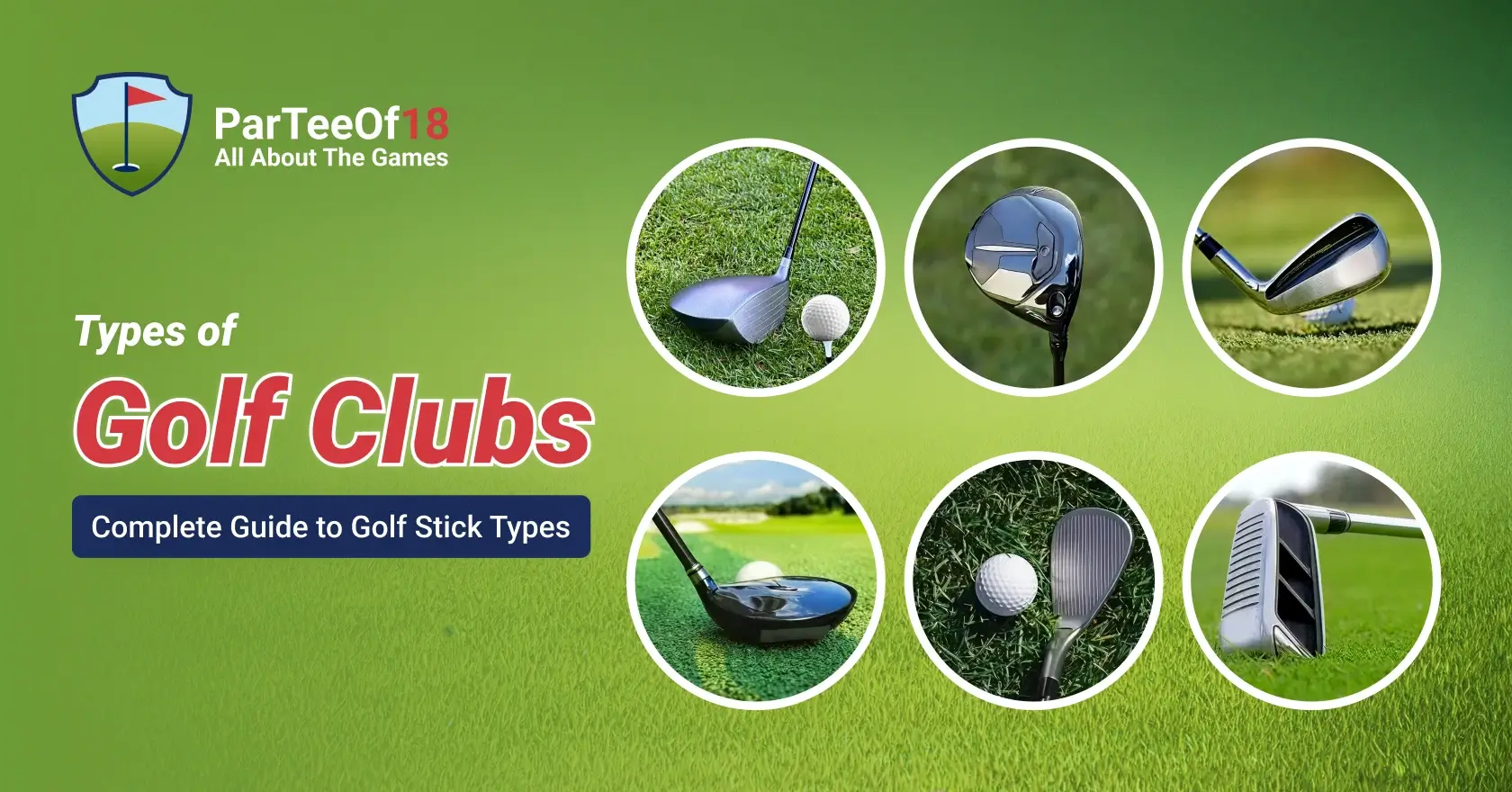
Golf appears simple on the surface, yet selecting the appropriate club significantly impacts the outcome of every stroke. Knowing the types of golf clubs you possess allows for more assured, consistent, and controlled play. Each club serves a distinct function; some are engineered for distance, others for precision, elevation, or finesse around the putting surface.
Golf clubs have come a long way since their beginnings as wooden sticks. Now, they’re sophisticated pieces of equipment, crafted from contemporary materials and engineered with remarkable precision. Even with all this progress, the fundamental principle hasn’t changed: selecting the right types of golf stick for the shot at hand. Whether you’re driving down the fairway or carefully lining up a putt, understanding the capabilities of each type of golf clubs helps players, regardless of their experience, make better choices and ultimately play better.
Different Types of Golf Clubs And Their Uses
Choosing the right golf clubs for each shot can strongly influence the overall performance. Different types exist to cover distance gaps, allowing golfers to hit the ball accurately from a wide range of yardages. Each type of golf stick is designed with specific strengths to handle distance, height, or control depending on the situation.
Golf club falls into five main categories, helping players to build a balanced set. Under the 14-Club Rule, golfers are limited to carrying a maximum of 14 clubs or fewer, making smart club selection for consistent results.
Here is a breakdown for each category for types of golf clubs:
Drivers – The Tee Shot Club
Drivers are the longest types of golf clubs with the biggest clubheads, up to 460cc, the maximum size set by the USGA equipment regulations, and the lowest loft angles, usually between 8-15 degrees. The driver also called a 1-wood and is typically used for the first stroke from the teeing ground on Par-4 and Par-5s.
The large size of the driver’s clubhead is used for long-distance shots and helps to create a big sweet spot for more forgiving hits on an upward arc. The shaft features of 45-46 inches allow for maximum swing speed. Modern drivers are usually made of lightweight, strong titanium or carbon composite materials, while shafts are typically graphite, making this types of golf stick ideal for power.
Woods – Long Fairway Clubs
Fairway woods are shorter than the driver but longer than irons and require a ‘sweep’ off the turf. They are useful for long shots from the fairway or tee. Common fairway woods are 3-woods and 5-woods. Fairway woods have smaller clubheads than drivers, usually 160 to 180 cc.
3-woods have loft angles around 15 – 18 degrees, and they are good for tee shots on short par-4s or second shots on par-5s. 5-woods have more loft, about 20 to 22 degrees, making them easy to hit off the ground.
Modern woods use multi-material designs rather than a single metal. Most top-tier 2026 woods combine steel or titanium bodies with carbon-fiber crowns and tungsten weighting for better launch, lower spin, and stability. These types of golf clubs are built for distance and perform best with faster swing speeds, making them harder to use for slower swings.
Irons – Control and Accuracy Clubs
Irons are versatile types of golf clubs used for a wide range of shots. They have smaller, angled clubfaces and are numbered from 3 to 9. Lower-numbered irons hit the ball farther but are harder to hit consistently due to lower loft.
Long irons (3-5) are a lower loft, are more challenging to use, and are typically used for shots over 180 yards. Mid irons (6-7) offer a balance of distance and control and are commonly used for shots between 130 and 180 yards. Short irons (8-9) have high loft and provide higher accuracy, making them ideal for shots under 130 yards.
Golfers can choose an types of golf irons based on their skill level, as its construction material is stainless steel; most common, durable, and used in cavity-back(Game Improvement Irons) for better forgiveness on off-center hits, or forged carbon steel; softer feel and preferred by advanced players for blade irons(Player’s Irons) offering major control and feedback.
You May Also Checkout: Blades vs Cavity Back Irons: Which are Better For You?
Hybrids – Easy-to-Hit Long Clubs
Hybrid golf clubs combine elements of woods and irons, earning them the nickname “rescue” or “utility” clubs. They’re generally easier to hit than long irons, yet provide more control than fairway woods. A lot of golfers opt to swap out their 3, 4, or 5 irons for hybrids. These clubs feature wider soles and a lower center of gravity compared to traditional irons, which helps get the ball airborne more easily because a lower CG creates a higher launch angle with more spin than a long iron.
Hybrids come in a range of lofts, usually from 16 to 27 degrees. These types of golf stick is useful for long approach shots, tackling difficult lies in the rough, or even tee shots on par-3 holes. For many players, hybrids offer greater consistency and forgiveness than long irons.
Wedges – High-Loft Scoring Clubs
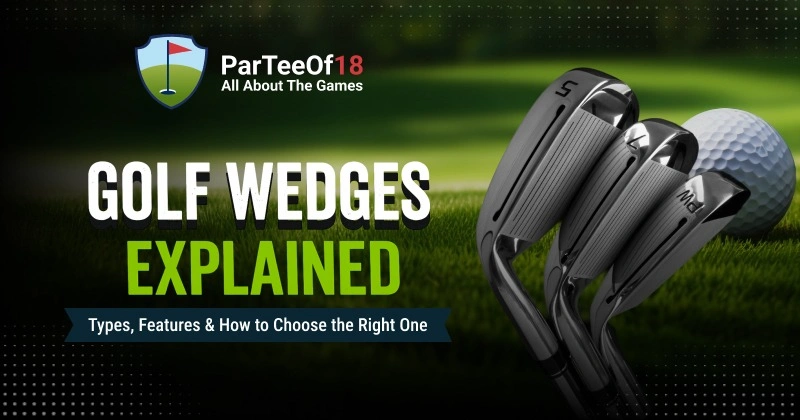
Wedges are specialized iron clubs with high loft angles, typically ranging from 46 to 64+ degrees. Wedges are essential for those precise, short-game shots near the green. Depending on their preferred approach and the course’s demands, golfers typically carry two to four wedges.
The primary types of golf wedges are:
- Pitching Wedge (PW) 43°-48°: Full approach shots from 100-130 yards.
- Gap Wedge (GW) 50°-54°: Fills the distance gap between PW and SW.
- Sand Wedge (SW) 54°-58°: Designed for bunkers and high-trajectory shots.
- Lob Wedge (LW) 58°-64°: High, short shots that quickly stop.
- High Loft Lob Wedge (64°+): Specialized shots with maximum height and minimum roll.
Checkout Dedicated Golf Wedge Guide For Detailed Breakdown
In addition to loft, bounce is a critical wedge feature. Bounce is the angle between the leading edge and the lowest point of the sole, acting like a skid plate to prevent the club from digging into turf or sand. Low bounce (4°-6°) suits firm lies and shallow swings, mid bounce (7°-10°) works best for most players and conditions, and high bounce (10°-14°) offers maximum forgiveness in soft turf, bunkers, and for steeper swings.
You May Also Checkout: Lob Wedge vs Sand Wedge: What’s the Difference and When to Use Each?
Chippers – Simple Bump-and-Run Clubs
Chippers are a specialized types of golf clubs designed for shots around the green and function as a hybrid between a wedge and a putter. The most important thing about it is that you swing it exactly like a putter (no wrist hinge). Chippers typically feature a loft between 32 and 42 degrees, resembling a 7- or 8-iron.
The clubhead has a wide sole, which prevents digging into the turf and promotes smooth contact with the ball. This design helps beginners or high-handicap golfers achieve more consistent results. To comply with R&A rules for tournament play, chippers must have one striking face, a non-flat grip(The “Grip” Rule), and be attached at the heel.
Putters – Green-Only Precision Clubs
Putters are a types of golf clubs designed for use on the green accounting for 40-50% of all shots in a round. They come in two main types: blade and mallet. Each style has unique features that can affect a golfer’s performance when trying to sink the ball into the hole.
Blade putters have a simple, narrow head with a length of 33 to 35 inches. They offer good feedback and are preferred by many skilled golfers. Mallet putters have a larger head with weight distributed around the edges, offering higher forgiveness. This design can help with alignment and stability in putting stroke.
For More Detailed Comparison, Checkout: Blade vs Mallet Putter: The Ultimate Guide
Putters are constructed from a variety of materials such as durable stainless steel, soft carbon steel for feel, lightweight aluminum for large mallet heads, and premium, dense materials like titanium, tungsten, and copper, offering firmer, consistent feel. These can improve feel and help control distance. Putter length and grip size can be customized to fit a golfer’s stance and stroke.
You May Also Like: Types of Putter: How to Choose the Right One for You?
Basics of Golf Clubs
Golf clubs have undergone some significant evolution since their beginning as bent sticks used by early golf pioneers in 15th-century Scotland. While the basic components have remained consistent, modern clubs now feature advanced materials, refined designs, and enhanced performance compared to their original counterparts. Nearly all manufactured golf clubs consist of these three main components, as they work together to affect how far and high the ball travels after the impact. Understanding these elements helps golfers to choose the right types of golf clubs for different situations.
Loft
The clubface angle, which defines loft, determines both ball height and ball distance during flight. Clubs with high loft, such as wedges, launch a ball on a more vertical trajectory, enabling them to execute short approach shots that stop quickly on the green. Lower-lofted clubs produce a flatter trajectory and more distance. Loft angles vary across the bag, from about 8.5° on drivers for low, long shots to around 60° on lob wedges for high, soft landings, while putters sit close to 0°.
Shaft Length
The length of the shaft has an impact on both swing speed and swing control. The longer shafts that drivers and fairway woods use enable golfers to achieve higher swing speeds, which result in longer distances but make it more difficult to maintain control.
For average height golfers (5’7″–6’1″), drivers are typically around 45 inches long, while iron lengths decrease from about 39 inches in a 3-iron to 35.5 inches in a pitching wedge. A standard men’s 7-iron measures about 37.5 inches, while women’s versions are usually 1 inch shorter, offering better accuracy for precision shots.
Shaft Material
Golf club shafts are usually made of steel or graphite. Steel is sturdier and heavier, offering a firmer feel for greater accuracy, and is often used in iron clubs, offering better control and consistency. Graphite, on the other hand, is lighter and more flexible, which can help increase distance and slower swing speed. These types of golf stick is superior for shock absorption, often chosen by players with joint pain or arthritis.
Also Checkout: Graphite vs Steel Shafts: Which Is Better for You?
How to Choose the Right Type of Golf Club for Each Shot?
Choosing the right type of golf clubs goes beyond simply matching a club to a yardage. Golfers must consider how the ball sits on the ground (the lie), along with shot distance, course layout, wind direction, and surrounding hazards. Each club is designed to deliver either power or precision, and selecting the proper one helps improve accuracy and shot control in different playing situations.
For long shots, distance and forgiveness are key, whereas approach shots require accuracy, suitable loft, and touch. Beginners often focus on distance alone, but considering factors like wind and course conditions leads to better results. Understanding these concepts enables golfers to make informed decisions and enhance their performance.
Golf Club Selection Guide
Here’s a quick reference table to help you match each shot scenario with the ideal types of golf clubs:
| Shot Scenario | Ideal Club | Selection Factors |
|---|---|---|
| Driver off the tee | Driver | Maximum distance from tee, narrower fairways, or shorter holes with preferred accuracy |
| Fairway tee shot | Fairway Woods or Hybrid | Long-distance targets, useful when accuracy is needed |
| Long approach (200+ yds) | Fairway Wood, Hybrid, or Long Iron (3-5) | Covers a long carrying distance; consider laying up if hazards are present |
| Short approach (<100 yds) | Wedges | High loft for stopping near the hole; choose based on the needed trajectory or spin |
| Chip shots near the green | Wedges (Gap/Sand/Lob) or Short Irons | High loft & control for short pitches and soft landings; choose based on roll vs carry. |
| Recovery from rough | Hybrid, Mid-Iron, or Wedge | Loft to lift out of grass; hybrid cuts through tougher lies; wedges for short pop-ups. |
| On the green | Putter | Focus on accuracy & controlling speed to roll the ball directly into the hole. |
You Might Also Like: A Beginner’s Guide to Complete Golf Club Set.
How Many Golf Clubs a Beginner Needs?
Most beginners think they must carry all 14 clubs, but you can play great golf with a well‑chosen set of 9–11 clubs. In simple terms, there are five main types of golf clubs: woods (including the driver), hybrids, irons, wedges, and putters, plus a few optional specialty clubs like chippers and high‑loft lob wedges.
Here’s a practical starter setup many new golfers use:
- Driver (or 3‑wood if you prefer control over distance)
- 1 fairway wood (3‑wood or 5‑wood)
- 1 hybrid (to replace a hard‑to‑hit long iron)
- 5–6 irons (for example: 5, 6, 7, 8, 9)
- 2 wedges (pitching wedge + sand or gap wedge)
- 1 putter
This gives you a simple, forgiving 10–11 club setup that still covers all common yardages without overwhelming you with choices. As you gain confidence and understand your distances, you can add extra wedges, another hybrid, or a specialty club like a lob wedge or chipper to fine‑tune your bag.
FAQs
What materials are golf clubs made from?
Golf club heads are typically made from stainless steel (Cast or Forged) or carbon steel. Drivers, on the other hand, often incorporate titanium or carbon composites. This choice is all about achieving both distance and a lighter weight.
What does “P” indicate on a golf club?
The letter “P” on a golf club signifies a pitching wedge (PW). These clubs have a loft of 42-49°, making them ideal for approach shots that reach up to 130 yards.
How are golf clubs categorized?
Clubs are generally categorized into several types: woods are designed for distance, irons are used for mid-range shots, hybrids offer versatility, wedges are for the short game, and putters are, of course, for putting.
What is an “A” wedge used for?
The “A”(Approach) wedge, also known as a gap wedge, typically has a loft of 50-52°. It’s specifically designed to fill the yardage gap between a pitching wedge and a sand wedge.
What’s the difference between a wedge and an iron?
Wedges and irons differ significantly. Wedges have higher lofts, ranging from 45° to 64°, and are designed for spin and control. Irons, in contrast, have lower lofts, from 20° to 45°, and are used primarily for distance.
Do you need a pitching wedge if you already have a sand wedge?
Yes, the PW is essential for shots that are 110-130 yards, and it works in tandem with a sand wedge for bunker shots and chips around the green.




 3D Green Maps
 Handicap Lookup
 Live
Scorecard & Leaderboard
Live
Scorecard & Leaderboard Digital
Wallet
Digital
Wallet Randomizer