
 Golf Tips & Education
 MacKenzie Tyler
 May 19, 2026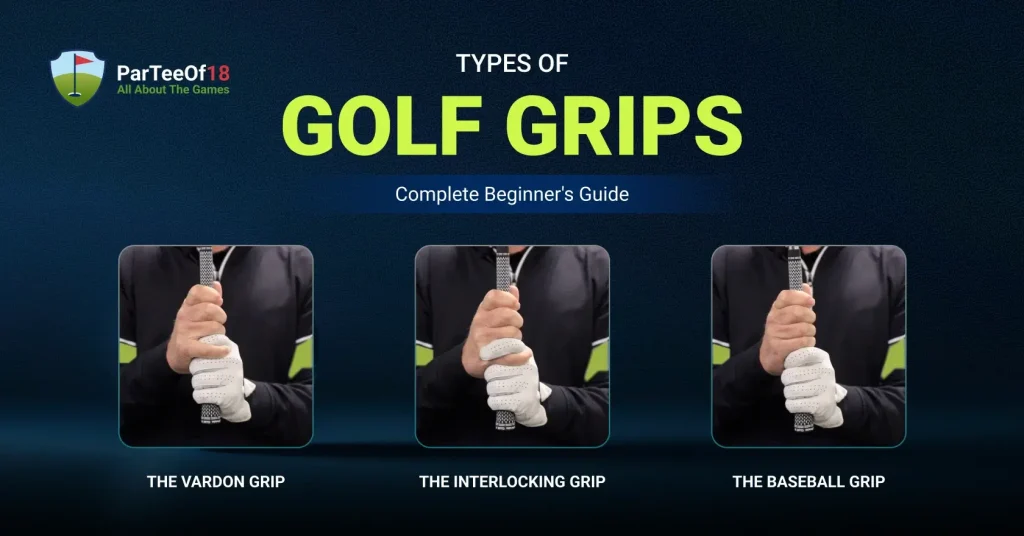
 Last Updated: July 3, 2026


Your hands are the only connection between you and the club, and how you position them changes everything. The grip style you choose affects how the clubface sits at impact, how much wrist action you generate, and whether the ball goes where you intended.
Most golfers learn one grip style early on and never question it. But there is a reason the Vardon, interlocking, and baseball grips each have loyal followings across different skill levels and hand sizes. Beyond how you hold the club, grip strength, neutral, strong, or weak, quietly shapes your shot shape and swing path.
And putting is an entirely different conversation, with its own set of grip styles built around control rather than power. This guide breaks down every types of golf grips, how each one works, who it suits, and how to figure out which combination actually fits your game.
The 3 Types of Golf Grips
When golfers talk about different types of golf grips, they’re usually referring to how the hands connect to the handle. There are three recognized methods for how to hold a golf club, and each has its own style, its own following, and its own set of advantages.
1. The Vardon Grip (Overlapping Grip) – Most Popular Worldwide
The Vardon grip, also called the overlapping grip, was popularized by English golfer Harry Vardon in the late 1800s, and became the dominant grip style in golf history.
To perform with this grip, start by placing your lead hand (the left hand for right-handed golfers) on the club as you normally would. Next, position your trail hand so that the pinky finger rests on top of or overlaps the gap between the index and middle fingers of your lead hand. Make sure both thumbs are pointing down the shaft. The V-shapes formed by each thumb and forefinger should point approximately toward your trail shoulder.
The Vardon grip is best for golfers with average to large hands and those with sufficient finger and hand strength to control the club. It’s the grip presented in most professional instruction and used by the majority of touring professionals.
Pros
- Encourages excellent hand unity throughout the swing, promotes a neutral clubface & reduces overactivity from the trail hand, which is a common cause of errant shots.
- A comfortable, natural fit for golfers with larger hands, allowing the hands to settle in without feeling forced or crowded.
- Promotes reduced hand tension throughout the swing, which quietly improves consistency and feel through the ball.
Cons
- Golfers with smaller hands or shorter fingers may find the overlap connection feels unstable, almost as if the hands are working independently rather than together.
- Golfers with weaker grip strength are likely to find it harder to manage control, especially on longer shots, where the club tends to shift at the top of the backswing.
2. The Interlocking Grip
The interlocking grip is exactly what it sounds like; instead of overlapping, the pinky of your trail hand and the index finger of your lead hand actually interlock; they lock together between the fingers. The remaining hands are positioned the same as in the Vardon grip. This grip is famously used by Jack Nicklaus and Tiger Woods, which alone highlights its lineage.
The interlocking grip is particularly well-suited to golfers with smaller hands, shorter fingers, or those who struggle to keep the club from slipping during the swing. Junior golfers, and players just getting started often feel an immediate sense of security when they use the interlocking grip.
Pros
- Creates a very secure, locked connection between both hands that holds up well under pressure.
- Great for players who feel the club is moving at the top.
- Ideal for smaller hands and shorter fingers, giving you a more controlled, confident hold.
- Encourages reduced grip tension, which supports a more consistent, straight ball flight.
Cons
- Can feel restrictive for those with larger hands.
- Some golfers report discomfort or pain in the pinky finger, particularly during extended practice sessions.
- Can cause discomfort or joint pressure at the interlock point over time.
- May slightly restrict wrist mobility, which can limit feel on the finer, narrower shots.
3. The Baseball Grip (10 Finger Grip)
In the baseball grip, or 10 finger grip, all fingers are firmly placed on the handle, with no overlapping and no interlocking. Your trail hand will simply sit directly below the lead hand, with all fingers in contact with the grip. The pinky of your trail hand rests firmly against the index finger of the lead hand without any linking.
This 10 finger grip is the most natural golf grip for beginners, children, seniors, and anyone with arthritis or finger joint pain. If you’ve ever held a baseball bat, the grip will feel immediately familiar.
Pros
- Maximum grip security, beginner-friendly, and easy on the joints.
- All ten fingers on the club can help generate extra power and clubhead speed, especially for golfers with limited wrist action or strength.
- A great confidence-builder for those just starting out.
Cons
- The two hands can work more independently, which sometimes leads to inconsistent shots.
- The trailing hand’s greater surface contact can cause an overactive release, leading to unwanted draws or hooks if not managed carefully.
- Harder to control distance and touch around the greens compared to the interlocking or overlapping methods.
- Rarely used by low-handicap or professional players, as it tends to produce less consistent results at higher levels of the game.
Quick Comparison – Vardon vs Interlocking vs Baseball
Each type of golf grips has its place; it really depends on your hands, your experience, and what feels right. Here’s how they compare at a glance.
| Feature | Vardon (Overlapping) | Interlocking | Baseball (10 finger) |
|---|---|---|---|
| Hand Connection | Trail pinky rests on the gap between lead index/middle fingers | Trail pinky interlocks with the lead index fingers | All 10 fingers in the club, no overlap/interlock |
| Best For | Average/large hands, professionals | Small hands, juniors | Beginners, seniors, and children |
| Feel | Secure, stable, structured | Locked-in, unified | Natural, maximum power |
| Pros | Reduces hand tension; consistent | Prevents hands from working separately | Easy to learn; Can aid clubhead speed |
| Cons | Uncomfortable for smaller hands | Can cause finger pain for some | Less control or consistency |
| Tour Use | Mostly used on the PGA Tour | Used mainly by Tiger and Nicklaus | Rarely used on Tour |
Types of Putting Grips
Putting is an entirely different skill from the full swing, and the putting grip styles used on Tour reflect that. The priority shifts from power to stability, alignment, and minimizing wrist movement.
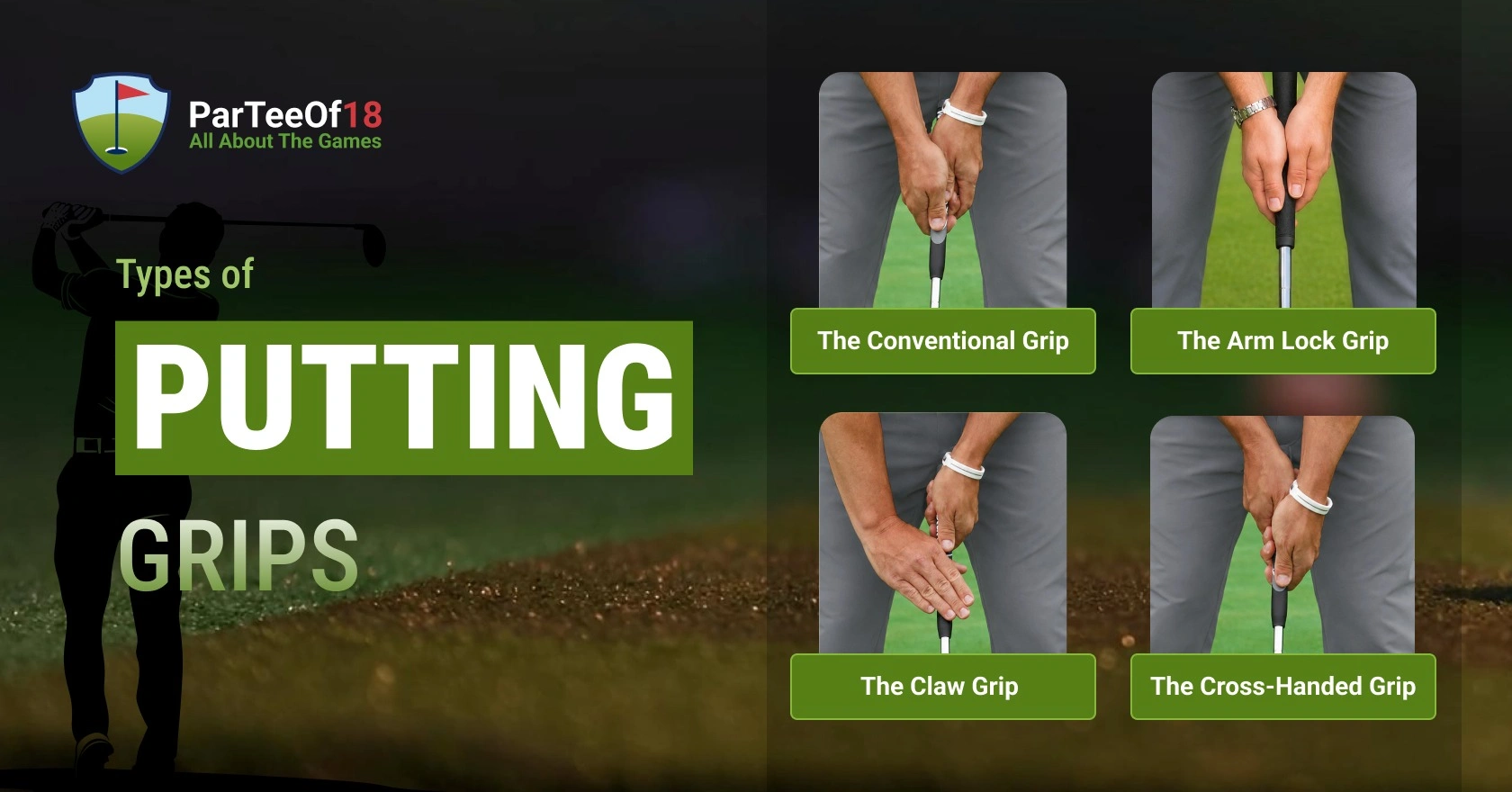
1. The Conventional / Reverse Overlap Putting Grip
The reverse overlap putting grip is the traditional and common standard. Unlike the full-swing Vardon grip, where your trail pinky overlaps, here the lead index finger overlaps the fingers of your trail hand. Both of your thumbs run straight down the flat front of the grip. This setup locks the hands together and quiets wrist action, exactly what you want on the putting green.
2. The Cross-Handed Grip (Left Hand Low for Righties)
In the cross-handed grip, your trail hand moves to the top of the grip while your lead hand drops below, which is the opposite of the conventional grip. Many recreational golfers who struggle with a “wristy” putting stroke find that their technique stabilizes immediately. It naturally levels the shoulders at address, which can improve your stroke arc and reduce the tendency to flip the putter face through impact.
3. The Claw Grip
The claw grip is an alternative putting technique where the lead hand holds the club normally, while the trailing hand assumes a “claw-like” shape to rest against the shaft without wrapping around it. The fingers are used only to lightly guide the putter, not to control the stroke. This style is especially helpful for players who are fighting the yips, because it reduces the trail hand’s influence during the stroke.
4. The Arm Lock Grip
The arm lock grip is a specialized technique designed for maximum stability by anchoring the putter to your lead forearm, effectively turning the arm and putter shaft into a single rigid unit. This grip is popularized by players like Bryson DeChambeau, and Keegan Bradley and the specified style nearly eliminates independent wrist movement, producing a pendulum-like stroke controlled more by the shoulders than the hands. It requires a longer putter and a specific setup, but for players who struggle with consistency, it can be a genuine improvement.
Golf Grip Strength
This is one of the most misunderstood concepts in golf instruction. Grip strength in golf is not about how hard you squeeze; it is about how far your hands rotate on the club at address. It directly affects the clubface at impact and is critical to achieving a proper grip on the golf club that matches your natural swing.
The easiest way to check: look at how many knuckles of your lead hand are visible when you look down at the address. The V-shaped golf grip, where the V is formed between your thumb and forefinger on each hand, is another reliable reference point.
The Neutral Grip
In a neutral grip, you can see two knuckles of your lead hand at address, and the V of both hands points toward your right shoulder or ear (for right-handed golfers). This is the standard approach for most golfers because it helps keep the clubface square at impact and promotes straighter, more consistent shots.
The Strong Grip
A strong grip involves rotating both hands slightly clockwise on the handle (for right-handed golfers), revealing three or more knuckles of the lead hand. The V’s point toward the trail shoulder or beyond. This tends to close the clubface at impact, encouraging a draw shot or helping players who slice the ball. Many top players, including Dustin Johnson and Bubba Watson, play with a strong grip.
The Weak Grip
A weak grip causes the hands to rotate counterclockwise, which may reveal only one or no knuckles of the lead hand, with the V’s pointing toward the lead shoulder. This grip tends to open the clubface, resulting in a higher ball flight and potentially leading to fades, pushes, or slices, and offering high control, which is favored by players aiming to reduce hooks or manage fast swing speeds.
But there is one question that immediately comes to mind when choosing the club, how to know if grip is too strong or weak. It is easy to see that if you’re consistently hitting hooks without trying, your grip is likely too strong. Consistent slices with no other obvious cause often point to a weak grip.
Golf Grip Pressure (This Is Not the Same as Grip Strength)
Grip pressure in golf is entirely separate from grip strength, and confusing the two is one of the most common mistakes beginners make.
Grip strength is where your hands are on the club. Grip pressure is how tightly you hold it.
When figuring out how tight to hold a golf club, the classic teaching cue is to imagine holding a tube of toothpaste without letting it squeeze out, firm enough to stay in control, but not so tight that you’re strangling it. On a scale of 1 to 10, most instructors recommend a 4 or 5 for full shots.
Excess tension in golf grip is one of the great swing killers. Tight forearms restrict the natural unhinging of the wrists through the hitting zone, which naturally reduces both distance and feel. Maintaining light, consistent pressure throughout your swing allows your hands and wrists to generate maximum speed and sensitivity, especially around the greens.
How to Choose the Right Golf Grip Type for You
For a golf grip for beginners, the interlocking or baseball grip is the safest starting point; it provides stability without requiring much hand strength. As your game improves, most instructors will suggest transitioning to the Vardon grip for its superior feel and hand unity.
For big hands, the Vardon/overlapping grip tends to be the most comfortable, since larger hands don’t need the locking security that the interlocking grip provides. Grips sized “midsize” or “jumbo” can also make a significant physical difference.
The best golf grip style for any individual depends on hand size, physical condition, skill level, and personal feel. The most important rule or guideline to remember is to practice whatever grip you choose consistently. Even a technically imperfect grip becomes reliable through repetition.
Start Your Smarter Golf Journey Today!


FAQs
What’s the best types of golf grips?
For most golfers, the Vardon overlapping grip, combined with neutral grip strength and moderate grip pressure, is the standard recommendation. But “best” is personal; it’s the one that helps you hit the ball where you’re aiming consistently.
Do all pro golfers interlock their fingers?
No. Most tour professionals use the overlapping Vardon grip. A notable group, including Tiger Woods and Jack Nicklaus, uses the interlocking grip. Very few use the baseball grip at the tour level.
What is the best type of golf grip for big hands?
Golfers with larger hands generally do better with the Vardon/overlapping grip and a midsize or jumbo grip. Big hands can feel crowded in the interlocking style.
How do I know if my golf grip is too strong or too weak?
A simple check: look at your lead hand knuckles at the address. Seeing three or more with V’s pointing past the trail shoulder = strong grip. Seeing only one knuckle with V’s pointing toward the lead shoulder = weak grip. Consistent hooks suggest too strong; consistent slices with good swing mechanics often point to too weak.
What’s the difference between putting and swinging grips?
Full swing grips prioritize power, wrist hinge, and control through a large range of motion. Putting grips prioritize stability, face control, and reducing wrist involvement. The techniques are not interchangeable; most players use an entirely different hand position and grip style on the green than they do off the tee.
All Premium Features Unlocked
No catch. Cancel anytime




MacKenzie Tyler is a competitive golfer preparing to turn professional on the LPGA Tour. A former All-League golfer and three-sport athlete, Tyler spent nine seasons caddying at Sebonack Golf Club on Long Island, where she developed a thorough understanding of the game. In 2025, she won the Long Island Amateur at -4 over 36 holes, qualified for the U.S. Mid-Amateur, and became the first alternate at her U.S. Women's Open qualifying site after leading the field through round one.


Related Posts

What Is Lag Putting? (And the 3 Drills That Actually Fix It)
Learn what lag putting means, why distance control matters, and three practical drills to help reduce three-putts and improve your...

What Is PCC in Golf? Playing Conditions Calculation Explained
PCC is the daily adjustment that corrects your score differential when a course plays easier or harder than its rating....

What Is a Fairway in Golf? Definition, Why Position Matters, and How to Hit More of Them
A fairway is the closely mown grass between tee and green. Learn what counts as one, how FIR works, and...

What Is Closest to the Pin in Golf? Rules, Variations, and How to Run It Right
Learn what closest to the pin means in golf, why it's called KP, how it runs in tournaments and casual...