
Have you ever gone to play golf with feeling a bit scared because the people you are playing with look to be scoring par whereas you keep adding double bogeys to your scorecard? You are not the only one. If you have come across the terms ‘Handicap Index’ or ‘Course Handicap’ and still don’t understand them, you might be wondering what is a handicap in golf is and why should I have one at all?
The response is quite straightforward: the golf handicap is the most influential tool in the sport when it comes to fairness. It is the numerical device that makes it possible for a novice to compete on the same level with a veteran who is experienced. In fact, it is the tool that makes the delight of competition, the fun, and the fairness accessible to every player, no matter what their skill level is.
Are you willing to learn about this crucial figure – golf handicap meaning and how to get one? We will explain it here.
What is a Golf Handicap?
So, what is a handicap in golf? A Handicap Index is basically a single, portable number that represents the potential skill level of a player.
One can compare it to a worldwide rating. It is based on the player’s best recent rounds, so it is very much a reflection of what the player is capable of on a good day. The best part? This Index travels with you. When you show up at a new course, your Index is converted using that specific course’s difficulty (the Course Rating and Slope) to give you your Course Handicap for the day.
Why bother with it?
- It makes the competition fair: For instance, if your Course Handicap is 20 and your friend’s is 10, you will be granted 10 additional strokes for the whole round. No arguments, just competitive golf.
- It tracks your journey: Watching that number drop over time is the most satisfying way to measure your improvement.
Categories of Handicap in Golf
The World Handicap System (WHS) refers to the terms as three separate entities and it is essential for you to understand the difference:
| Handicap Category | Definition | Where is it used? |
|---|---|---|
| Handicap Index | Your baseline ability number. It stays put until your next score update. | Used to calculate your Course Handicap at any club. |
| Course Handicap | The number of strokes you are actually owed based on the specific tees you’re playing today. | Used to determine your Playing Handicap. |
| Playing Handicap | The number of strokes you apply in the competition format (e.g., 90% of Course Handicap for Fourball). | Used for official competitions and casual bets. |
What Each Handicap Type Means
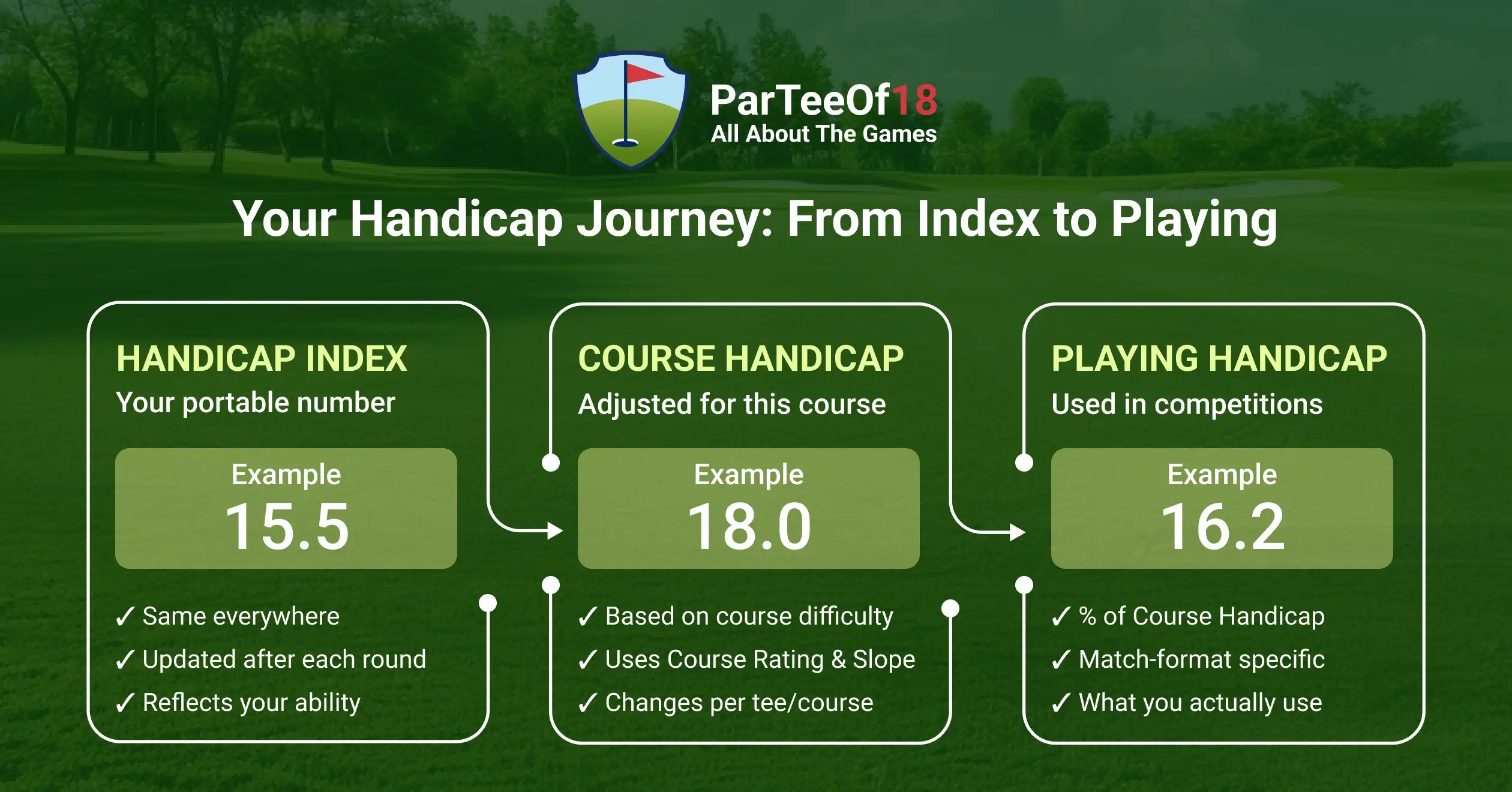
Handicap Index:
This is your personal baseline ability number that stays the same globally. Think of it like a credit score – it’s your number that travels with you. It’s calculated from your best 8 scores out of your last 20 rounds and gets updated whenever you post a new score. Whether you play at your home course or travel to a championship course, your Index doesn’t change.
Course Handicap:
This is your Index translated for one specific course and tee. It answers the question: “How many strokes do I actually get today?” A Handicap Index of 12 might become a Course Handicap of 14 at an easy course or 16 at a difficult course. The Course Rating and Slope Rating of the tees you’re playing determine this conversion. You calculate a new Course Handicap every time you play a different tee or course.
Playing Handicap:
This is the final number you use in specific competition formats. It’s often a percentage of your Course Handicap depending on the match type. For example, in Four-Ball match play, you only play with 90% of your Course Handicap. So if your Course HC is 18, your Playing HC becomes 16.2 for that format. Different games use different percentages to keep competition fair.
Typical Handicap Ranges
| Handicap Level | Handicap Index Range | What It Means |
|---|---|---|
| Low | 0–10 | Skilled, competitive golfer |
| Mid | 11–18 | Regular, average club golfer |
| High | 19+ | Beginner, casual, or improving golfer |
What is a good golf handicap?
A “good” handicap in golf depends on experience level, practice time, and how long someone has been playing, rather than a single magic number. In general, anything in the mid-teens or lower is considered solid for regular club golfers, while single-digit handicaps are often seen as very strong amateur performance.
- Beginners: New golfers often start with handicaps in the 28–40+ range while learning basic swing and course management.
- Average club golfers: Many recreational players fall somewhere around the mid-teens to mid-20s, depending on how often they play and practice.
- Low-handicap and scratch golfers: Single-digit handicaps (0–9) are usually considered low, and a handicap of 0 (scratch) or better is typically associated with highly skilled competitive amateurs.
Few Highlights of The World Handicap System (WHS)
Since 2020, the WHS has created a single set of rules for golfers everywhere. The system is essentially what allows for the scores to be comparable and consistent no matter where you play Golf, maybe in the US, Europe, or Asia. If you want to see the rules that govern the whole system, then you should look at the official USGA Rules of Handicapping. This helps clearly define what is a handicap in golf for players globally.
Firstly, it is good to be aware of the main points of the system:
- The system is based on your best 8: The Handicap Index is determined by the average of the best 8 score of the last 20 rounds. So, it will not be a source of trouble for you when you play badly!
- You can start fast: You only need to post scores from 54 holes (three full 18-hole rounds) to get your first Index.
- Net Double Bogey Cap: If you have one truly awful hole (a shank into the water, perhaps?), the WHS has a built-in safety net. For handicap purposes, your score on that hole is capped at a Net Double Bogey, preventing one bad hole from wrecking your Index.
- Maximum Index: The highest Index anyone can hold is 54.0, which means even total beginners can get involved right away.
To understand how these changes impact your score, you can read our detailed guide: How does golf handicap work?
WHS, USGA, and R&A: Understanding the Governing Bodies
You may have heard about USGA and R&A when reading about handicaps. Here’s what they do and how they relate to the WHS. The World Handicap System (WHS) is the global rulebook created by two major golf organizations working together:
United States & Mexico (USGA):
The USGA (United States Golf Association) manages golf rules and handicapping for the U.S. and Mexico. They implement WHS rules through affiliated clubs and courses. If you play in America, your handicap follows USGA-managed WHS guidelines.
Europe, Asia, Australia & Rest of World (R&A):
The R&A (Royal & Ancient Golf Club) based in Scotland manages golf rules for everywhere else. They also use the WHS framework. If you play in the UK, Europe, Asia, or Australia, your handicap follows R&A-managed WHS guidelines.
Whether you’re playing in Florida, France, or Tokyo, the rules are identical. Your Handicap Index of 15 means the same thing globally. The WHS unified handicapping so golfers can travel and compete fairly anywhere in the world.
How WHS Changed Handicapping: Old System vs New
The World Handicap System introduced several key improvements that make golf fairer and more connected globally. Here’s how the new system compares to what came before:
| Feature | Old System (Pre-2020) | New WHS (2020 Onwards) |
|---|---|---|
| Index Range | Varied by country (0-36 in US, different elsewhere) | 0.0 to 54.0 globally (same everywhere) |
| Calculation Base | Best 10 of last 20 rounds | Best 8 of last 20 rounds |
| Update Frequency | Monthly or quarterly updates | Real-time (can update daily) |
| Portability | Limited to country/region | Fully global (play anywhere) |
| Bad Hole Protection | Hole scoring cap varied | Net Double Bogey cap (consistent) |
| Getting Started | 54 holes minimum | 54 holes minimum (same) |
How to Calculate Handicap?
Determining your handicap index is a complex task that involves many variables and hence requires a special formula. As such, it’s recommended that this be done by an official golf club or a duly accredited app.
Simply put, the golf handicap calculation is based on your adjusted gross scores and it uses two numbers to determine the difficulty of the course: Golf Course Rating and Slope Rating of the golf course. The actual golf handicap index formula involves, For each round calculating the Score Differential = (Gross Score – Course Rating) x 113 / Slope Rating. Then the best 8 Score Differentials from the last 20 rounds are averaged.
You are not required to perform the calculations yourself but knowing the factors is definitely worth your time. In case you are interested in the formula and would like a detailed explanation of each step, you can check our guide on How to calculate golf handicap.
How Do You Improve Your Golf Handicap?
Reducing your Handicap Index is the main objective of most golfers, which is basically a confirmation that you are improving your game! Although practice is very important, if you focus your effort strategically, you will be able to lower that number much faster.
There are a few quick, high-impact tips to improve golf handicap :
- Focus on Par-3 Courses: Start posting from shorter courses to establish your index faster with better scores. Once solid, challenge tougher layouts. This builds confidence while stabilizing your index quickly.
- Track Performance by Course Rating: Notice which course ratings you play best on. If you consistently shoot better on 69.5 vs. 72.0 courses, play more in that range. Maximize wins in your capability zone before tackling tougher courses.
- Play Full 18-Hole Rounds: WHS only counts complete 18-hole rounds (or combined 9-hole rounds). Prioritize full rounds to post scores faster and give the system more data, helping your index stabilize quicker.
- Aim for Consistency Over One Great Round: Ten rounds of 82-85 improve your index more than one 72 mixed with five 88s. Build a pattern of repeatable solid play—your best 8 of 20 matter most.
- Practice Short Game (A Lot): This is where you save strokes. Dedicate more time to chips, pitches, and putting from inside 50 yards than to hitting your driver.
- Play the Percentages: Don’t always pull out the big stick. On hard holes, focus on a 3-wood or even an iron that you can comfortably and consistently handle in order to be sure that you are always in the fairway.
- Think Big: The best place to aim when going for the green is the center of the green if you don’t have a wedge in your hand. Hitting the center means avoiding bunkers and water, minimizing bogeys.
- Know Your Scoring Limit: Use the WHS Net Double Bogey cap to your advantage. If you’ve hit three bad shots, don’t keep hacking. Pick up the ball, mark down your maximum score, and move on to save your mental game.
- Get Fitted for Putting: You use your putter more than any other club. A simple fitting can drastically improve your stroke consistency.
FAQs
How do I calculate my golf handicap?
The simplest way is to use an official tracking method (like a registered app or club software) after playing and recording at least 54 holes. In case you want a quick notion of your level, our Handicap Estimator can be a rough calculation.
What is a Course Handicap and how is it different than my Handicap Index?
Your Handicap Index is a measure of your baseline ability and it stays the same no matter where you play. Your Course Handicap is the number you arrive at when you adjust your Index based on the specific tees and course difficulty you’re playing that day.
Here’s a practical example: Say your Handicap Index is 15. On Monday, you play at Riverside Course from the White tees (Slope 120, Course Rating 71.5) – your Course Handicap becomes 17. On Wednesday, you play at Mountain Course from the Blue tees (Slope 135, Course Rating 73.0) – your Course Handicap becomes 19 because Mountain is harder. Your Index stays 15, but your Course Handicap adjusts based on each course’s difficulty. This is how the system ensures fairness whether you’re playing an easy 9-hole par-3 course or a championship layout.
What is the Maximum Hole Score?
Handicap calculations consider the maximum score for one single hole to be a Net Double Bogey.
The maximum score on a hole is therefore considered to be:
Par + 2 strokes + any handicap strokes received on that hole.
What is the maximum Handicap Index?
The highest Handicap Index that is permitted under the World Handicap System (WHS) is 54.0.
Why would I need a Handicap Index?
Indeed, an Index is a must-have officially if you intend to take part in club tournaments, charity events, or any other kind of formal golf competitions. It lets you go by the rules and get a fair number of strokes off against other rivals.
Do I need a handicap to play socially?
Social golf does not require an official Handicap Index. You can continue to play socially by employing easier formats such as Stableford or Matchplay, and without an official Index. However, having one makes friendly wagers and match play more engaging and balanced, helping everyone understand what is a handicap in golf and how it applies to their round.
Do I need a handicap to play in tournaments?
Many friendly or local events don’t require an official handicap, but most club and official tournaments do because handicaps are used to keep scoring fair.
Can my handicap be negative?
Yes. A negative handicap is called a “plus handicap,” and it means the golfer is better than scratch and gives strokes back in competitions.
How often is my handicap updated?
With modern systems, your handicap index is usually updated every day that you submit an acceptable score through a recognized club or app.