
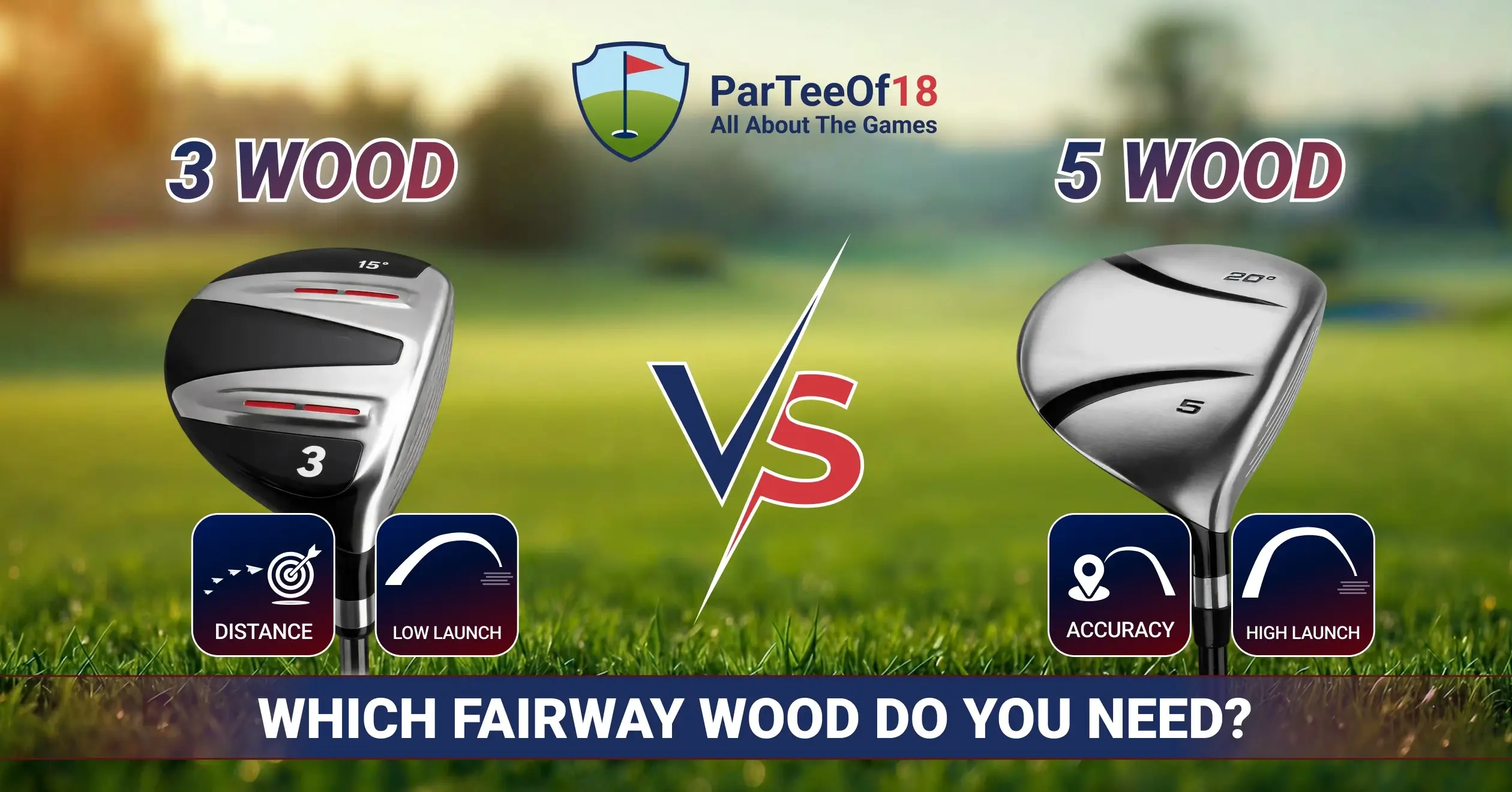
Ever stood on the tee box staring down a tight fairway and wondered which club gives you the better shot, the 3-wood or the 5-wood? I’ve been there more times than I can count. Before we get into the 3 wood vs 5 wood debate, here’s the quick picture: a wood in golf is a club with a large head and a longer shaft built for distance. It’s typically used for tee shots or long fairway hits, and despite the name, modern woods are made from metal or composite materials.
In my experience, this debate isn’t just about distance; it’s about confidence. At times, the 3-wood strikes the ball with incredible accuracy. On other occasions, opting for the 5-wood is clearly the wiser choice. The real key is understanding when each club deserves to be in your hands.
What is a 3 Wood?
If there’s one club I’ve relied on more than almost any other in my bag over the years, it’s the 3-wood. A 3-wood usually has a loft of 13° to 15°(can go up to 16° or 16.5°) and is made to hit the ball far and with control. This gives the ball a lower, more piercing flight with a shaft length of 43 to 43.5 inches, it is also the second-longest club in the bag.
When a driver is too aggressive, but an iron won’t cover enough ground, this is the club I suggest. When I was playing, I often thought of the 3-wood as my “fairway finder with teeth” because it usually gets me 220 to 250 yards with average swings.
Players have relied on the 3-wood for a long time. As per the Golf Digest, Jack Nicklaus famously used the same 3-wood for record 37 years because he trusted its accuracy.
What is a 5 Wood?
The 5-wood is the club that many golfers underestimate, until they start hitting it. The 5-wood is often referred to as the “Swiss Army Knife” of golf clubs. It typically has a loft ranging from 17° to 19°, although some high-launch versions or adjustable models can have a loft of 20° or 21°.
Additionally, the graphite shaft of a 5-wood is usually ½ inch to 1 inch shorter than that of a 3-wood. It launches higher, carries slightly shorter distances, and lands softer than a 3-wood. In the last ten years, I’ve seen more players get better at their long games just by switching to a 5-wood.
For long approaches of 180 to 210 yards, I usually choose a 5-wood over a long iron. The higher launch gives you stopping power, especially on greens that are hard.
At the 2008 Open Championship, Pádraig Harrington hit the 17th green at Royal Birkdale Golf Club with a 5-wood, trusting its high launch and soft landing to execute a bold approach in the strong winds. This shows that a 5-wood can hit aggressive shots with more accuracy than long irons.
3 Wood vs 5 Wood at a Glance
Here’s how I explain the difference between 3 wood vs 5 wood during fittings and lessons:
| Features | 3 Wood | 5 Wood |
|---|---|---|
| Loft | 13°-15°; can go up to 16° or 16.5° | 17°-19°; can be adjusted to 20° or 21° |
| Distance | Maximum distance | Controlled carry |
| Launch | Lower | Higher |
| Roll | More rollout | Softer landing |
| Forgiveness | Moderate | More forgiving |
| Ideal For | Tee shots & long par 5s | Approach shots & consistency |
Players with higher swing speeds often maximize a 3-wood, and players who seek consistency and an easier launch usually benefit from a 5-wood.
Key Differences Between 3 Wood and 5 Wood
Deciding between a 3 wood vs 5 wood isn’t a matter of which club looks more impressive. Instead, it’s about which one will help you hit more fairways, achieve greens in regulation, and create better opportunities for birdies. Below are some important differences between the 3 wood vs 5 wood:
Loft & Launch Angle
The loft is the biggest separator between these two types of golf clubs. From what I’ve seen, the main difference between a 3 wood vs 5 wood is how high the ball goes and how it launches. A 3 wood usually has a loft of 13° to 15°, which means the ball will fly lower and roll more after landing. This is great for hitting the ball as far as you can from the tee or making a long shot from the fairway.
A 5 wood, on the other hand, usually has 17° to 19° of loft (sometimes even 20°), which makes the ball go higher and land softer. A 5 wood is a great choice for long approach shots or when I want to be more forgiving because it makes it easier for me to get the ball in the air.
I’ve played on fast courses where a 3 wood simply wouldn’t hold the green from 230 yards out. Switching to a 5 wood allowed the ball to land softer and stay on the putting surface.
When To Choose Each?
Knowing how the angle of the clubface, or loft, affects how high and far the ball goes is important for choosing the right 3 wood vs 5 wood golf club:
- Need a piercing flight into the wind; choose 3-wood
- Need height to carry a bunker or water; choose 5-wood
- Firm greens that reject low shots; choose a 5-wood
Distance & Trajectory
On average, a 3 wood flies 10-20 yards farther than a 5 wood when struck well. In real-world play, I’ve seen many golfers hit their 5 wood almost as far as their 3 wood because they make more consistent contact. A solid 210-yard carry beats a mishit 3 wood that travels 185.
The path of the ball is also a clear difference between the 3 wood vs 5 wood. When I hit the ball with a 3 wood, it usually goes lower and straighter. This is good for links-style courses or when I want the ball to run after it lands. The 5 wood, on the other hand, sends the ball higher and farther, and it lands more gently on the green.
On long par 5s with room to run, I’ll reach for a 3 wood to get close enough for a chance at eagle. But into guarded greens, I prefer the height and control of a 5 wood so the ball lands soft and holds.
Practical advice: Track your average carry distance, not just your longest shot. Consistency lowers scores.
Forgiveness & Ease of Use
In my experience, most golfers find it easier to hit the 5 wood. The extra loft makes a big difference because it increases backspin, which keeps the ball’s flight steady and makes shots more consistent. I’ve also noticed that the extra loft makes it easier for the ball to launch, even when the contact isn’t perfect. Because of this, some shots with a 5 wood usually end up with a tighter distance range.
The 3 wood, on the other hand, has a longer shaft and a lower loft, which makes swing mistakes more obvious. And that’s when the 5 wood became the better choice to keep the ball in play, even on days when my swing doesn’t feel quite right.
Over the years, I’ve experienced:
- High swing speed + consistent strike: 3-wood performs beautifully.
- Moderate swing speed or inconsistent contact: A 5-wood often produces better scoring results.
There’s no ego in smart equipment choices. I’ve carried both clubs in different seasons, depending on the types of golf courses I was playing and how I was striking the ball.
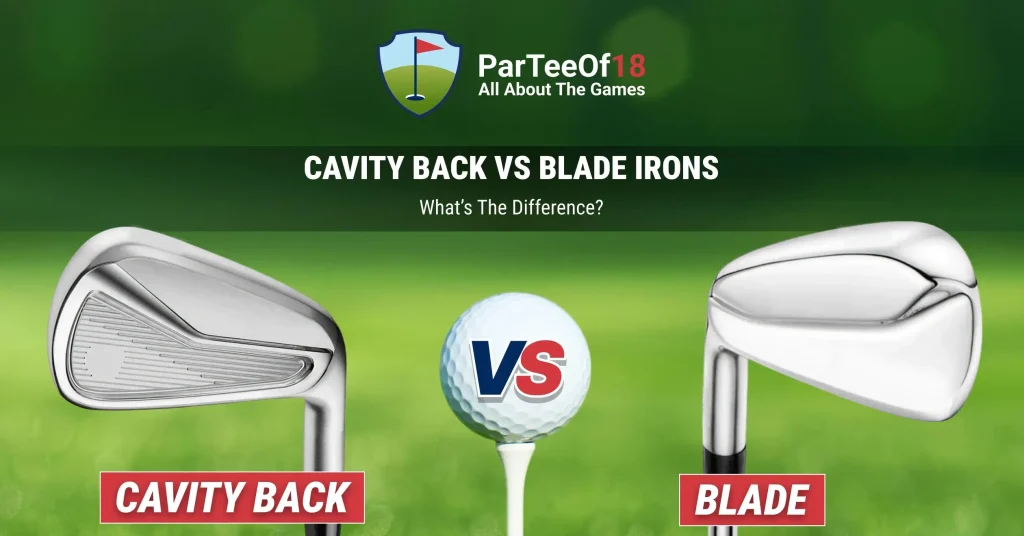
You May Also Checkout: Types of Golf Irons Explained: From Cavity Back to Blades
Which Is More Reliable for Accuracy Off the Tee?
This is the most common question I get. The answer depends on the player for pure accuracy, but a lot of golfers think the 5 wood is more reliable. The shorter shaft, which is usually about 1/2″ to 1″ shorter than a 3 wood, is one big reason. It gives me a little more control over the swing. The extra loft also helps by making the ball spin more, which keeps it on course instead of letting it drift off course. Also, I just find it easier to hit the center of the face more often with a 5 wood.
Strong ball strikers often choose a 3 wood off the tee for its distance and accuracy, especially on narrow par-4s. Higher-handicap players typically find more success with a 5 wood, which can lead to birdie opportunities or scrambling to save par.
If hitting the fairway is more important to you than distance, try both and keep track of how many fairways you hit.
3 Wood vs 5 Wood: Which is Better for Beginners?
In my opinion, the 5 wood is one of the best golf club for beginners to start with. The higher loft makes it much easier to get the ball up in the air, which is something that a lot of new golfers have trouble with. It also forgives more, since it has a bigger sweet spot that helps when contact isn’t perfect, it also glides through the grass more easily, which makes shots from the fairway less scary. Honestly, just seeing that extra loft at the address makes me feel a little better before I swing.
A beginner trying to hit a 3 wood from the fairway often has trouble with shots that are too thin or too low, whereas the loft of the 5 wood helps the ball get in the air, even if you don’t have perfect technique.
When new players join the game, I usually recommend starting with a forgiving 5 wood, but I don’t typically consider a 3 wood until later in the process. In my experience, building confidence leads to consistency, which in turn leads to skill development.
Choosing the Right Fairway Wood for You
Here’s how I help players choose between a 3 wood vs 5 wood during fittings.
Pick a 3-wood if you:
- Have a faster swing speed (typically 95+mph)
- Consistently hit the center of the face
- Need a controlled tee club that isn’t a driver
- Play on courses that are windy or hard-packed
Pick a 5-wood if you:
- Want a simpler, easier to hit options
- Need more stopping power on approach shots
- Have trouble with 3-wood consistency
- Prioritize forgiveness over maximum raw distance
Also, think about how these clubs will fit in with the rest of your bag. You will often need a hybrid club or strong long iron to fill the gap between your irons and your 3 wood. A 5 wood can naturally fill in the gap between your driver and your longer irons, making the distance between clubs in your bag more even.
Start Your Smarter Golf Journey Today!


FAQs
Why is a 7 wood easier to hit than a 3-wood?
A 7-wood is easier to hit than a 3-wood because it has a higher loft (20°-22° vs. 15°) and a shorter shaft, which gives it a higher, more consistent launch with more control. The higher loft and shorter length make it easier to sweep the ball off the ground, which gives you more stability and forgiveness.
How far should I hit a 5-wood?
The average golfer can hit a 5-wood between 170 and 210 yards. The most common distance is between 190 and 195 yards. It is made for shots that go high and land softly on long par 4s or 5s. It is often used to fill the gap between a 3-wood and a 3-hybrid or 4-iron.
What is a 3-wood supposed to replace?
A 3-wood (with a loft of 13° to 16°) is better for control than a driver off the tee, or it can be used instead of a long iron like a 1-iron, 2-iron, or 3-iron, for long fairway shots that go higher and are easier to hit. Some golfers switch it out for a 5-wood or 3-hybrid to make it easier to launch, and it is usually used for shots that need to go 215 to 250 yards, like tight par 4s or long par 5 approach shots.
What is a 5-wood supposed to replace?
A 5-wood is usually better for long shots than a 2-iron or 3-iron because it is easier to hit and more forgiving. It has a loft of 17° to 19°, which can sometimes be changed to about 20°. This gives it a higher flight while still covering the same distance, which is usually around 200 to 230 yards for most golfers. The 5-wood is a popular choice for mid- to high-handicap players who hit long approach shots because it has more launch and forgiveness than long irons.
Is it harder to hit a 3-wood than a 5-wood?
Yes, a 3-wood is usually harder to hit than a 5-wood. The 3-wood has a longer shaft and a lower loft (about 15°), so you need to swing it faster to get it to launch and control it. The 5-wood has a shorter shaft and a higher loft (17°-19°), which makes it easier to hit off the ground. This makes it more consistent and accurate.



 3D Green Maps
 Handicap Lookup
 Live
Scorecard & Leaderboard
Live
Scorecard & Leaderboard Digital
Wallet
Digital
Wallet Randomizer