

 MacKenzie Tyler
 April 15, 2026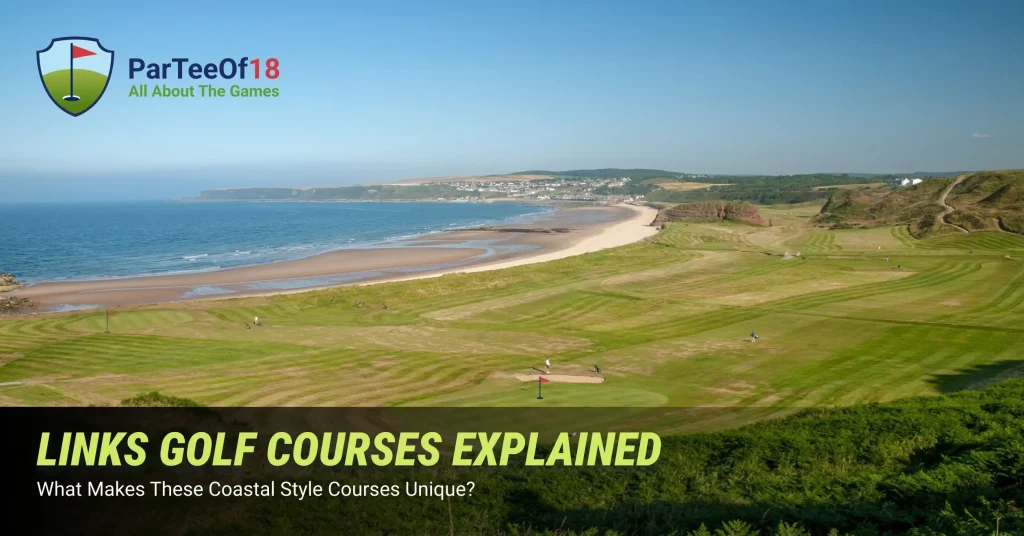
 Last Updated: July 3, 2026


If you’ve ever caught a major played along a windswept coastline, fairways rolling like dunes, and players constantly adjusting to the breeze, it’s hard not to wonder what is a links golf course, and why it feels so different from the neatly trimmed course most people are used to.
Links golf is one of the oldest ways the game is played, shaped far more by the land and weather than by design plans or heavy landscaping. For beginners, especially, it’s not just another course type to learn; it’s really a glimpse into how golf first came to life. In the sections ahead, we’ll break down where it comes from and why it still stands out as one of the most demanding yet enjoyable forms of the game.
What is a Links Golf Course?
A links golf course is a coastal course built on sandy land that connects the sea to inland terrain. It features firm, fast-draining soil, rolling dunes, few trees and strong winds, encouraging low, ground-based shots rather than high aerial play. To be a genuine link, the course must be built on this specific geological foundation, a rare landscape that accounts for less than 1% of the approximately 270 of the world’s 30,000 golf courses.
Origin and History of Links Golf Club
The history of the Links Golf Club is inseparable from Scotland’s coastline. For hundreds of years, golf was a rugged, informal pastime played on common land. However, as the game grew in popularity during the 1700s, players began forming “societies” to establish rules and organize competitions.
The term “links” comes from the English word hlincas, plural of hlinc, meaning rising ground or ridges of sandy soil that connect the sea to fertile inland farm land. The land is too salty and wind-swept for crops; it’s essentially “waste land” where locals began hitting balls into rabbit holes centuries ago. This type of golf course is characterized by its coastal location, a lack of trees, firm turf, and deep “pot” bunkers. Unlike the lush, manicured parkland courses you might see in the U.S. suburbs, a links course is meant to be played “on the ground,” meaning you bounce and roll the ball toward the hole rather than flying it there through the air.
The Society of St Andrews Golfers, founded in 1754, eventually became the Royal and Ancient Golf Club (R&A) of St Andrews after it was granted royal status in 1834. Much later, in 2004, things changed again, and the club and the game’s governing role went their separate ways, with the R&A taking over the global administration of golf while the club remained a private members’ institution.
He didn’t build these courses in the modern sense; he simply curated what nature provided. The layout was dictated by the natural gaps in the gorse and the paths cleared by sheep. This “minimalist” origin is why many historic links courses, like the Old Course at St Andrews, have such quirky, irregular features. They represent a time when the club wasn’t just a place to play but a community guardian of the unique, windswept terrain that gave rise to the sport.
What Constitutes a Links Golf Course?
To truly understand what constitutes a links golf course, you have to look past the scorecards and the clubhouse. In the world of golf architecture, a course to be considered a true link, it must possess a specific structure composed of four essential elements:
1. The Linksland Geography
The most non-negotiable requirement is the land itself. True linksland is the sandy strip of terrain that “links” the sea to the arable farmland further inland. This land is essentially a prehistoric seabed. Because it is composed of deep sand, it is incredibly absorbent. Rain doesn’t puddle on a links course; it disappears. This creates the signature firm, fast-playing surface that defines the game’s origins.
2. A Treeless, Windswept Landscape
If there are towering pines or hardwoods lining the fairways, then it isn’t a links. On the coast of Scotland or Ireland, the salt-laden gale-force winds, and thin, sandy soil make it impossible for large trees to take root. Instead, the landscape is defined by:
- Gorse and Broom: Prickly, thick shrubs that take in golf balls.
- Marram Grass: The tall, wispy dune grass that stabilizes the sand.
- Natural Undulations: The crumpled look of the fairways isn’t man-made; it’s the result of centuries of wind moving sand into dunes, and ridges.
3. Strategic Pot Bunkers
On an inland course, bunkers are often flashed up onto hillsides so the golfer can see them. On a links, bunkers are often blind pits or deep pots. Historically, these weren’t designed by architects; they started as hollows where sheep huddled to escape the wind, wearing away the turf until the sand was exposed. To keep the sand from blowing away, these bunkers are often “revetted,” lined with stacks of sod, creating steep, vertical walls that require a vertical escape.
4. The Ground Game Philosophy
Because links courses are exposed to constant coastal winds, the “aerial game” (hitting high, soft shots) is often impossible. A true link is a design that encourages, and often forces, the bump-and-run.
- Hard Fairways: The ball should bounce and roll significantly.
- Open Fronts: Unlike parkland courses that might have a pond or a bunker guarding the front of a green, a links green is almost always open at the front to allow a ball to be rolled onto the putting surface from 50 yards out.
What are Links Style Golf Courses?
A links-style course is essentially a “tribute act.” It is a course built on land that isn’t naturally coastal “linksland” (such as inland meadows, deserts or former quarries), but is designed to mimic the aesthetic and strategic challenges of the Scottish coast.
Architects use heavy earth-moving equipment to create man-made dunes, deep pot bunkers, and undulating fairways. While they often succeed in capturing the look of a classic links, the fundamental difference usually lies beneath the grass.
The Links-Style vs. True Links: The Difference
The terms get used interchangeably all the time, but they’re not quite the same, and that distinction matters more than most people realize. Somewhere along the way, “links-style” became a convenient label for anything that looks the part, even if it doesn’t share the same roots. To really understand what separates the two, you have to look past appearances and get into what actually defines a true links course at its core.
- The Soil (The Foundation): A True Links sits on sandy, porous soil that drains instantly. This creates a “firm and fast” surface where the ball can roll for 50 yards after landing. Links-Style courses are often built on clay-heavy or loamy soil. Even if the grass looks brown and wispy, the ground is often softer, meaning the ball stops much sooner.
- The Vegetation: True linksland is virtually treeless because the salt spray and high winds prevent large trees from taking root. You’ll find gorse, marram grass, and fescue. A Links-Style course might purposefully remove trees or plant tall “fescue-look” grasses to simulate that wide-open, wind-swept feeling, even in the middle of a forest or a prairie.
- The “Ground Game” vs. “Aerial Game”: On a True Links, the wind is often so strong that “flying” the ball to the green is a recipe for disaster; you have to play “along the ground.” On many Links-Style courses, especially in the U.S., the greens are still designed to be approached through the air, even if the bunkers look like they belong in St Andrews.
- The Climate: A True Links is defined by the maritime climate, constant wind, “mizzle” (mist/drizzle), and rapidly changing weather. A Links-Style course in a place like Arizona or Michigan may look the part, but without that heavy, salty air, the strategy of the game changes entirely.
Why the Distinction Matters
For a golfer, the difference is strategic. On a True Links, the “rub of the green” (the luck of the bounce) is part of the soul of the game. On a Links-Style course, you often get the visual beauty and rugged aesthetic of the seaside, but with the more predictable, controlled conditions of a modern inland course.
What Makes Links Golf Unique & Difficult?
Links golf is the game in its rawest, most ancient form. Unlike the manicured “parkland courses” common in the U.S. Links land is found where the sea meets the shore, built on sandy soil that drainage forgot and sculpted by centuries of coastal winds. What makes it unique is its unpredictability. On a standard course, if you hit a high, straight shot, you’re rewarded. On a links course, a perfect shot can catch a hidden hummock and bounce 40 yards into a “pot bunker,” those deep, sod-walled pits that look more like archaeological digs than hazards.
For example, imagine you are standing on the 14th fairway at St Andrews (The Old Course). You have 150 yards to the pin. On a normal course, you’d pull an 8-iron, aim at the flag, and stick it.
At St Andrews, you might be facing a 30-mph headwind coming off the North Sea. If you hit that 8-iron high, the wind will swallow it and dump it short. Instead, you take a 5-iron, choke down on the grip, and play a “stinger,” a low, piercing shot that skips along the turf like a stone across a pond. You have to aim 20 yards left of the green because the natural slope of the land will “feed” the ball toward the hole. You aren’t just playing against the par; you’re playing a game of physics and intuition against the terrain itself.
In short, links golf is difficult because it strips away your yardage book and forces you to use your imagination. It’s less about a perfect swing and more about survival and creative problem-solving.
Most Famous Links Golf Courses
Links golf is the sport’s original form, played on sandy coastal land where the sea meets the shore. The most popular courses are concentrated in the United Kingdom, and Ireland, but the style has expanded globally to regions like Oceania and North America.
Here is a curated look at the world’s most iconic links, stripped down to what actually makes them legendary:
The Classics (UK & Ireland)
St Andrews (Old Course): The literal blueprint of the sport, where history and pot bunkers dictate every strategic move. This golf course, considered by many to be the “home of golf,” is the world’s most famous links course, having hosted more Open Championships than any other venue. Additionally, this links golf club is set to host next year’s 155th Open for the 31st time in 2027.
Muirfield: A brilliant, circular puzzle designed so that the wind tests your resolve from a different angle on every hole.
Royal Birkdale: This links golf club is frequently voted as the top links course in England because it offers a “stern but fair” challenge, and will return to these Southport links for the 154th Open Championship in 2026.
Royal Portrush: Northern Ireland’s coastal jewel, offering a relentless, high-drama test through massive Atlantic dunes, where Scottie Scheffler claimed the title and won the 153rd Open in July 2025.
Trump Turnberry (Ailsa): Home to the game’s most famous lighthouse and a seaside stretch that is visually unmatched in Scotland, and a regular site for high-profile amateur and corporate events like the Turnberry International Challenge.
Royal County Down: A rugged masterpiece where the jagged Mountains of Mourne meet the world’s most intimidating “bearded” bunkers.
Lahinch: Often called the “St Andrews of Ireland,” it’s a quirky, towering dune-land experience that defines “fun” golf. This golf course hosted the Irish Open in 2019 and is slated to host the Walker Cup in September 2026.
The Modern Masterpieces (Oceania)
Tara Iti: An ultra-exclusive, strictly private club, sand-based marvel that looks and plays like a pristine, prehistoric version of the Scottish coast. This course does not host public professional tournaments, though it remains a top-ranked venue for private member-guest events.
Cape Kidnappers: A vertigo-inducing layout perched on dramatic finger-like ridges of land high above the New Zealand surf, which makes it a more event-specific destination and gained fame with the ‘Kiwi Challenge’ in 2008-2009, in a high-stakes PGA challenge season, and the tournament was later discontinued after 2009.
Barnbougle Dunes: A rugged Tasmanian treasure that proves world-class links golf doesn’t have to be exclusive or expensive.
The North American Icons
Pebble Beach: America’s most famous shoreline, where the ocean isn’t just a view, it’s a hazard on almost every iconic cliff-top hole; recently, this golf course hosted the AT&T Pebble Beach Pro-Am in February 2026, won by Collin Morikawa.
Cypress Point: An elusive, private masterpiece that culminates in the most breathtaking three-hole finish in the world.
Bandon Dunes: A pure, true links, fescue-covered sanctuary in Oregon that finally brought the authentic “ground game” to American soil.
Cabot Cliffs: This link golf club is a world-renowned, top-ranked public links course known for dramatic, high-cliff ocean views and varied terrain that hangs delicately over the Nova Scotian cliffs. This is the primary venue for the PGA Women’s Championship of Canada.
Global Standouts
Lofoten Links: A surreal Arctic experience where you can play off granite rocks under the glow of the Northern Lights. This link golf club hosts the annual Arctic Golf Challenge, with the 2026 edition currently accepting registrations.
Hoiana Shores: An authentic links-style golf course in Vietnam that has quickly become the new standard for links golf in Asia, and was awarded “World’s Best New Golf Course” in 2020.
Humewood: A long-time host of the South Africa Open, offering a classic, wind-swept challenge at Africa’s only true links, on the shores of Algoa Bay.
Tee data and 3D green maps for 30,000+ links courses — all in the free app!


Tips for Playing Links Golf
If you’re new and trying to figure out how to play links golf, the biggest adjustment is changing how you think about the game. Links golf isn’t about hitting high, perfect shots; it’s about adapting to the ground and the wind.
One of the most important tips is to keep the ball low (punch or knockdown shots). On a links golf course, wind is almost always a factor, and high shots can easily get pushed off target. Instead, focus on controlled, lower shots that stay under the wind.
Another key adjustment is learning to play for roll and to use the ground (bump and run). Because the terrain is firm, the ball can travel much farther after landing. Rather than aiming directly at the target, you often need to land the ball short and let it run toward the hole.
Selecting the different types of clubs also becomes more strategic. You may find yourself using a longer club for shorter distances simply to control trajectory and roll. This is very different from what most beginners are used to on parkland courses.
Finally, patience is essential. Even good shots can take unexpected bounces due to the natural terrain. Accepting this unpredictability is part of learning links golf, and over time, it actually becomes one of the most enjoyable aspects of the game.
FAQs
What makes a golf course a true links course?
A link course is situated by the coast, constructed from sand, and created using the natural landscape, without many modifications made during construction.
Why are links golf clubs more difficult?
Links golf is harder because of strong winds, firm ground that increases ball roll, unpredictable bounces and deep bunkers that penalize mistakes.
Which majors are played on the Links golf club?
The main major championship played on links courses is The Open Championship (or British Open), which rotates its venues across different UK coastal links courses annually.
Why is it called hitting the links?
The “links” used in “hitting the links” refers to the name of the coastal golf course where the sport originated in 15th-century Scotland. The name “links” originates from the Old English word “hlinc” meaning rise, elevation or ridge. It represents sandy and treeless terrain between the coast and farm lands.
Can beginners play links golf courses?
Yes, beginners can play links courses, but they should be prepared for challenging conditions and focus on learning shot control and strategy.
How is links golf different from regular golf?
Links golf is played on natural coastal terrain with firm conditions and fewer trees, while regular golf courses are more landscaped, softer, and controlled.
All Premium Features Unlocked
No catch. Cancel anytime




MacKenzie Tyler is a competitive golfer preparing to turn professional on the LPGA Tour. A former All-League golfer and three-sport athlete, Tyler spent nine seasons caddying at Sebonack Golf Club on Long Island, where she developed a thorough understanding of the game. In 2025, she won the Long Island Amateur at -4 over 36 holes, qualified for the U.S. Mid-Amateur, and became the first alternate at her U.S. Women's Open qualifying site after leading the field through round one.


Related Posts

9 Fun Golf Putting Games to Play (Practice Green and On the Course)
Discover fun golf putting games for the practice green and real rounds, plus the drills that back them up and...

What Is a Chip Shot in Golf? How to Hit It and When to Use It
Learn what a chip shot is, when to chip vs. pitch vs. putt, and how to hit it clean. Simple...

What Is Lag Putting? (And the 3 Drills That Actually Fix It)
Learn what lag putting means, why distance control matters, and three practical drills to help reduce three-putts and improve your...

What Is PCC in Golf? Playing Conditions Calculation Explained
PCC is the daily adjustment that corrects your score differential when a course plays easier or harder than its rating....