

 MacKenzie Tyler
 April 16, 2026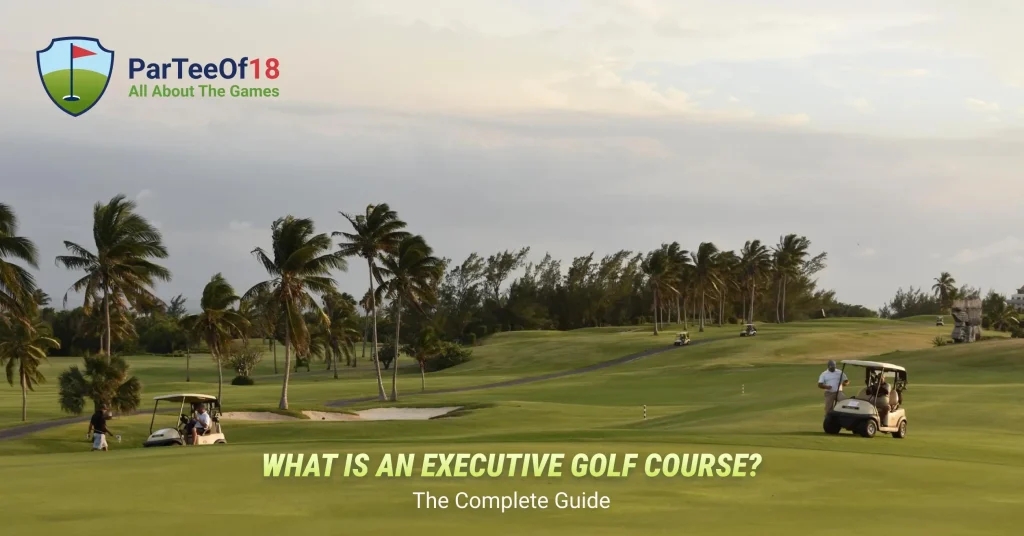
 Last Updated: July 3, 2026


Ever feel like traditional golf drags on forever? Four hours, endless walking, and somehow still stuck behind that one slow group. That’s where executive golf courses flip the script. Shorter, faster, and way more forgiving, they’re built for players who want the thrill without the marathon. But what is an executive golf course, really, and why are more golfers ditching full-length courses for these compact gems? There’s more to them than just shorter holes. From smart design to surprisingly competitive play, they pack a punch most people don’t expect. Curious why they’re becoming the go-to choice for busy golfers and beginners alike? Read on, this might just change how the game is played.
What Is an Executive Golf Course?
An executive golf course is a shorter, faster alternative to a traditional par-72 layout, designed to be played in significantly less time. The defining characteristic is its composition, as it consists primarily of par-3 holes, with a handful of short par-4s and rarely a par-5, for a total standard executive course par rating of 9 holes at 29-33 and 18 holes typically between 58-66, which is lower than regulation 18-hole courses.
Unlike standard golf courses, which have lengths between 5,500 to 7,500 yards, an executive golf course is considerably shorter and has lengths of 18-hole executive courses that range from 3,000 to 5,500 yards and a 9-hole course ranges from 1,500 to 2,700 yards. Executive golf courses offer a perfect halfway point between pitch and putt courses and normal courses.
Key Features of an Executive Golf Course
An executive golf course is defined by its compact nature and its focus on iron play. While it maintains the soul of the game, several distinct features separate it from a standard championship layout:
1. Distinctive Par Composition
What really sets an executive course apart is how heavily it leans on shorter holes. A regular regulation course mixes par 3s, 4s, and 5s pretty evenly, but these tracks do things differently. You’ll usually see way more par 3s than anything else, often more than half the holes, with just a handful of short par 4s mixed in, and rarely a par-5. They’re pretty rare, or sometimes missing completely. Because of that, the total par for 18 holes usually lands somewhere between 55 and 68, instead of the standard 72.
2. Compressed Yardage
These courses are a lot shorter overall, so they reward accuracy way more than raw power. You’re typically looking at a total yardage between 2,500 and 5,000 yards from the regular tees. That smaller footprint means they can squeeze into places where a full-sized course never could, such as tight residential neighborhoods or spots in town where land is at a premium.
3. Accelerated Pace of Play
One of the best things about executive courses is how quickly you can get around. You can usually knock out 18 holes in under three hours, and nine holes takes about an hour and a half. The distances between greens and tees are short, which makes them really walkable too. No endless marches across huge fairways as you get on those big championship tracks.
4. Technical Short-Game Focus
Don’t let the shorter length misguide you; these holes aren’t automatic birdies. Most executive courses have smaller greens and tighter fairways, so you really have to dial in your approach shots and putting. The designers often stick bunkers and water hazards in smart spots to keep the short par 3s from feeling too easy. It’s actually a great place to sharpen your short game instead of just hitting a few drives.
5. Multiple Tee Options
Multiple tees are the great equalizer on an executive course. By shifting the starting point, a single hole can act as a technical long-iron test for a low-handicapper or a simple pitch-and-putt for a beginner. This variety keeps the game inclusive, letting friends with totally different skill levels play together without anyone feeling out of place. It’s about making the round adjustable so the focus stays on the shots, not just the distance.
6. Urban/Suburban Land Footprint
Executive courses don’t need hundreds of acres; they can sit right in the middle of a neighborhood or a city block. They act as essential green spaces that thrive in tight spots, where a massive championship layout would be impossible. This proximity turns golf into a local, everyday activity rather than a day-long commute. In addition, a smaller footprint means less grass to water, and maintain, making these courses a much more sustainable fit for the community.
The Origin Story: Why Are They Called “Executive” Courses?
The word “executive” was a pretty smart fix for something that had started to bother a lot of people in the 1950s and 60s. Business was speeding up fast after the war, but a regular round of golf still took four hours or more. For the new wave of managers and executives trying to climb the ladder, that was a real problem; it just didn’t fit anymore.
That’s when architect William Mitchell started designing these shorter, no-frills courses by swapping long par-fives and filling the layout with quick par-threes instead. Suddenly, you could actually get in a decent game during your lunch break without feeling like you were slacking off. You kept your swing sharp and still got to do the whole networking thing with colleagues.
Calling them “executive” courses was the real genius move. Before that, short courses had this reputation as kid stuff or practice grounds. The new name flipped the script completely. It turned what used to feel like a downgrade into something that sounded efficient and important, like only serious, high-value people with packed schedules would play them. It was clever branding, honestly. It gave busy professionals a way to keep playing without apologizing for it.
Why Do Golfers Choose Executive Golf Courses?
Selecting an executive course is not a compromise, but rather a form of optimization. Whether you’re a harried executive squeezing in a round or a weekend golfer who just wants to play more often, these layouts make a lot of sense. Here’s why they work so well:
Skill Development
These courses are loaded with par-3s and shorter par-4s, so you spend way more time hitting irons, wedges, and putters. Most serious players will tell you it’s one of the best ways to sharpen your short game.
More Frequent Play
The biggest advantage of an executive course is the sheer speed of the round. Because you aren’t grinding through five-hour marathons, it’s actually possible to fit golf into a normal life.
You can squeeze in nine holes after work or a full eighteen on a weekend morning and still have the rest of your day intact. This efficiency turns golf from a rare, planned event into a routine hobby, allowing you to keep your swing sharp without sacrificing your schedule.
Low-Pressure Social Round
These layouts strip away the intimidation factor often found at championship clubs. It’s the perfect environment for a casual bet among friends or a relaxed family outing where the scorecard doesn’t feel like a high-stakes exam. Since the stakes feel lower, the enjoyment stays higher, making it much easier to actually talk and connect with the people you’re playing with.
Cost and Accessibility
Executive courses offer a laid-back, low-pressure alternative to stuffy private clubs, making them ideal for beginners, seniors, or anyone dodging a 7,000-yard slog. Since the smaller footprint is cheaper to maintain, green fees usually run 30% to 50% less than championship rates. Plus, their suburban locations mean you can get a round in without burning your entire day on a commute.
Difficulty and Demographics
They feel much less intimidating to new players. They’re also much easier to walk, which makes them ideal for seniors or juniors who don’t want to tackle a long 7,000-yard beast.
Minimized Green-to-Tee Transitions
Executive layouts are usually routed tightly, unlike big championship courses that feature long scenic walks (or cart rides) between holes. The next tee is often just a few yards from the green you just finished. It adds up to a surprising amount of saved time for both walkers and riders.
Executive vs. Par 3 vs. Standard Courses
This comparison highlights the basic differences among the formats. Although each specific type of golf course may have varying aspects, the standards listed above are used in the industry for categorization.
| Feature | Par-3 Course | Executive Course | Standard (Regulation) |
|---|---|---|---|
| 18-Hole Par | 54 | 60–65 | 70–72 |
| Total Yardage (18 holes) | 1,800–2,500 | 3,000–5,000 | 5,500–7,500+ |
| Average Play Time | 1.5–2 hours | 2.5–3 hours | 4–5+ hours |
| Common Hole Mix | 100% Par 3s | Mostly Par 3s, 4s & a Par 5 | Balanced Par 3s, 4s, & 5s |
Some of The Best Executive Golf Courses in U.S
The following courses represent the elite tier of American executive golf, blending the strategic depth of championship layouts with a brisk, and modern tempo.
The Short Course at Mountain Shadows: Widely considered the gold standard for the modern executive format, this par-54 desert layout in Paradise Valley was designed to challenge even low-handicappers with its fast, undulating greens and dramatic views of Camelback Mountain.
Golf Club at Audubon Park: A rare gem located in the heart of New Orleans, this 18-hole, par-62 course offers a sophisticated “parkland” experience. Its 4,220-yard routing is framed by centuries-old oaks and lagoons, providing a serene, high-quality round just minutes from downtown.
The Hay: While essentially a par-3 course, its 2021 Tiger Woods redesign elevated it to the executive level of play. It includes highly creative holes, such as a replica of the iconic 7th at Pebble Beach Links, that demand precise shot-making and strategic thinking.
Winter Park Golf Course: A beloved municipal course known as WP9, this layout is a masterclass in walkable, community-centric golf. It was recently renovated to offer strategic interest and exceptional greens in a compact, nine-hole format.
Sugar Mountain Public Golf Course: Perched at 4,000 feet in the Blue Ridge Mountains, this par-64 layout features an intriguing mix of nine par-3s, eight par-4s and a par-5. The elevation changes and mountain terrain provide a full-scale physical and mental challenge in an abbreviated format.
Eagle Crest Resort – Challenge Course (Oregon): Living up to its name, this par-63 executive option measures over 4,000 yards and is famous for its pristine conditions and varied hole designs that force players to use every iron in their bag.
You May Also Checkout: What is a Links Golf Course? Complete Guide
Executive Course Etiquette & Tips
The magic of an executive course lies in its tempo, but that rhythm only works if every player understands the unspoken contract of the short-course format. Because these layouts are designed to be “fast golf,” the primary etiquette rule is a radical commitment to momentum. This isn’t the place for a five-minute pre-shot routine or a deliberate, televised-style green reading. Instead, embrace Ready Golf in its purest form; if you are at your ball and the way is clear, take your shot, regardless of who is technically “away.”
Beyond the clock, remember that a shorter course often means tighter quarters. With tees and greens frequently clustered together, noise travels fast; keep your voice down and be acutely aware of adjacent fairways. On the green, the “executive” mindset means clearing the surface immediately. Save the scorecard marking and the post-hole analysis for the next tee box to keep the group behind you flowing. Finally, don’t let the shorter yardage make you lazy with course care. Because these courses see high volume in small windows, repairing your ball marks and replacing divots is essential to keeping the “compact” experience from feeling “worn out.”
Access detailed course data and ratings — right inside the app.


FAQs
How long does it take to play an executive golf course?
An executive round is designed to be completed in roughly 2.5 to 3 hours. If you are playing a 9-hole executive loop, you can often wrap up in under 90 minutes, making it the perfect “lunch break” or “after-work” round.
What constitutes an executive golf course?
An executive course is defined by its par and its variety. Unlike a par-3 course, which consists only of short holes, an executive course features a mix of par-3s and par-4s, with an occasional par-5. The total par for 18 holes usually sits between 58 and 65. It’s essentially a “scaled-down” version of a championship course that keeps the strategic diversity but removes the long-distance slog.
How long are executive golf courses?
These executive courses generally range from 2,500 to 5,000 yards for a full 18-hole experience. This is significantly shorter than the 6,500 to 7,500+ yards found on a regulation track. The holes are designed to be “compact,” meaning the walk between a green and the next tee is often just a few steps.
Who plays executive golf courses?
The executive golf courses are ideal for practicing the short game, offering an accessible, less frustrating, and often more affordable alternative to full-length courses, suitable for all skill levels. They are a sanctuary for beginners who aren’t ready for the intimidation of a 500-yard hole, seniors who prefer a walkable distance, and low-handicappers who want to sharpen their “scoring” clubs.
Do I need a full set of clubs for an executive course?
Technically, no. Because the holes are shorter, you will rarely need your long irons or fairway woods. Many players find they can navigate an executive course effectively with 8 to 10 clubs, specifically a driver or 3-wood for the par-4s, a few mid-to-short irons, and a diverse selection of wedges. It’s a great opportunity to carry a smaller, lighter “Sunday bag.”
Are executive courses cheaper than standard courses?
Almost always. Because the “footprint” of the course is smaller, maintenance costs for water, fertilizer, and labor are significantly lower. These savings are passed on to the player through lower green fees, which are often 30% to 50% less than nearby regulation courses. This makes it an affordable way to play more often without breaking the bank.
All Premium Features Unlocked
No catch. Cancel anytime




MacKenzie Tyler is a competitive golfer preparing to turn professional on the LPGA Tour. A former All-League golfer and three-sport athlete, Tyler spent nine seasons caddying at Sebonack Golf Club on Long Island, where she developed a thorough understanding of the game. In 2025, she won the Long Island Amateur at -4 over 36 holes, qualified for the U.S. Mid-Amateur, and became the first alternate at her U.S. Women's Open qualifying site after leading the field through round one.


Related Posts

9 Fun Golf Putting Games to Play (Practice Green and On the Course)
Discover fun golf putting games for the practice green and real rounds, plus the drills that back them up and...

What Is a Chip Shot in Golf? How to Hit It and When to Use It
Learn what a chip shot is, when to chip vs. pitch vs. putt, and how to hit it clean. Simple...

What Is Lag Putting? (And the 3 Drills That Actually Fix It)
Learn what lag putting means, why distance control matters, and three practical drills to help reduce three-putts and improve your...
What Is PCC in Golf? Playing Conditions Calculation Explained
PCC is the daily adjustment that corrects your score differential when a course plays easier or harder than its rating....