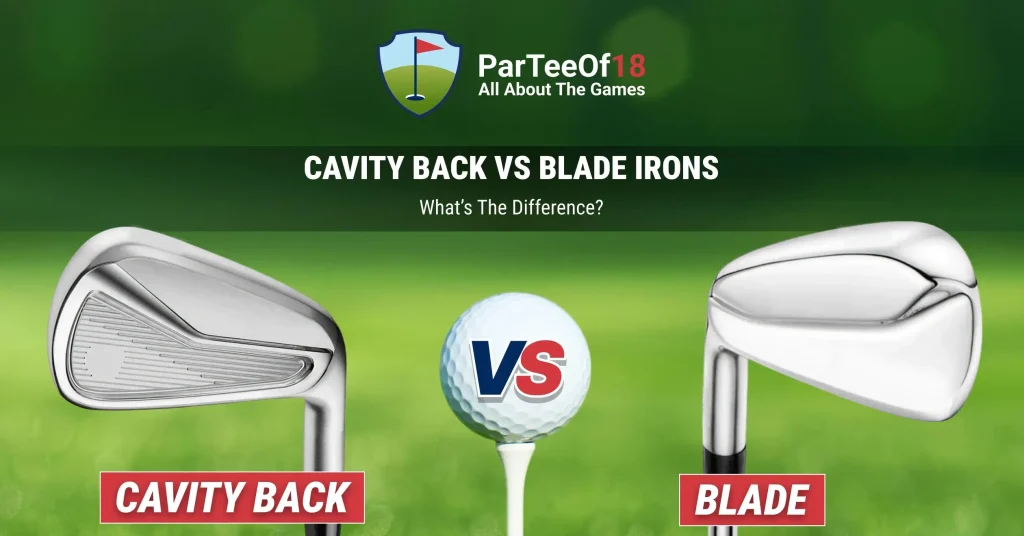
Choosing the right irons can make a bigger difference in your golf game than most players realize. One of the most common golf equipment questions golfers ask is; what is the difference between cavity back and blade irons? While both are designed to help you hit cleaner, more controlled shots, they’re built for very different types of players and playing styles. The conversation around blades vs cavity back irons usually comes down to forgiveness, workability, feel, and skill level.
And while they’re built differently, it’s worth noting that both still have to meet the USGA Equipment Rules for use in regulated play. If you’re trying to decide which iron style is best for your game, understanding these key differences is the first step toward making the right choice.
Quick Comparison: Blade Irons vs Cavity Back Irons
To make the blades vs cavity back comparison easier to understand, the table below lays out the most important differences at a glance. It’s a simple way to compare performance, forgiveness, control, and which type of golf iron is best for you.
| Features | Blade Irons | Cavity Back Irons |
|---|---|---|
| Head Shape | Smaller clubhead with a thin top line | Larger clubhead with a wider bottom |
| Weighting | Sits behind the middle of the clubface | Spreads around the outside of the clubhead |
| Center of Gravity (CG) | Balanced towards the center of the club | Balanced lower to help lift the ball |
| Forgiveness | Less forgiving if the center of the face is missed | More forgiving on the mishits |
| Shot Control | Easier to intentionally curve shots | More likely to fly straight |
| Ball Flight | Lower, more controlled flight | Higher flight that helps with carrying distance |
| Feel On Impact | Clear feel of how you struck the ball | Less feedback on the impact position |
| Best For | Confident, consistent ball strikers | Beginner/Intermediate and improving golfers |
What are Blade Irons?
The blade irons, also known as muscle backs, are a traditional type of golf club that are highly valued for their workability. Although golf irons can either be forged or cast irons, blade irons are typically forged using soft carbon steel. However, there is also a possibility that blade irons can be made using cast stainless steel.
The blade irons have a short shaft with a thin top line, a narrow sole, minimal offset, and a solid back. This is where the weight is concentrated behind the sweet spot. This feature ensures that golfers get immediate feedback when they hit the ball. This is particularly beneficial for skilled golfers because they can easily tell whether they have hit a good shot. Blade golf irons are typically recommended for skilled golfers as they do not offer forgiveness.
What are Cavity Back Irons?
The cavity-back irons are designed with a hollow clubhead that shifts weight to the perimeter, ensuring greater stability and forgiveness at impact. The increased MOI and the larger sweet spot of the cavity back irons allow for a greater launch, which is more consistent and predictable, thereby ensuring greater forgiveness at impact. This type of golf club is more suitable for beginners and intermediate to mid-handicap golfers.
Biggest Differences Between Blades vs Cavity Back Irons
When you are trying to choose between blades vs cavity back irons, the most important thing is to know what the biggest differences are. Even though both of these types of irons are great, they are designed for different skill levels, preferences, and performance. The sections below will give you a better idea of what each iron has to offer.
Design & Construction
The blade irons have a solid and compact look with weight located at the back of the clubface. This offers skilled golf players better sensitivity, accuracy, and control. On the other hand, the cavity back irons have a hollow back design that offers forgiveness and stability. In other words, blade irons are suitable for skilled golf players, while beginners can use cavity back irons.
Distance
The cavity back irons typically offer more consistent distance performance for the average golfer, especially in mishits. They have a higher MOI to retain ball speed in mishits, whereas blade irons tend to lose more distance in mishits due to the ball being struck away from the face center.
Forgiveness
Cavity back irons offer significantly higher forgiveness than blades, making them better for most golfers, while blades are designed for elite ball-strikers seeking precision over forgiveness.
Shot Shape/Workability
Blade irons vs cavity back irons differ mainly in the manner in which they manage shots, especially in terms of workability, which is largely dependent on the design of the clubs. Blades offer high precision and control over shots, while cavity backs provide straight shots with high forgiveness.
Feel and Feedback
Blades vs cavity back irons differ majorly in feel and feedback, as blades provide a softer feel, offering a more pure feel and precision feedback, which enables skilled golfers to know exactly the location of impact on the clubface, while cavity back irons provide more dampened feel, which is designed to reduce vibrations and cancel off-center hits.
Cost
Blade irons are 15-30% more expensive than cavity back irons. The biggest price differential between blades vs cavity back irons can be simply attributed to the manufacturing process and market appeal, with blade backs being more expensive due to the labor-intensive manufacturing process, while cavity back irons are more affordable due to their easier casting techniques.
Best For
Blades are forged for feel and control and are best for skilled golfers (low handicappers) who consistently make center face strikes. Cavity Backs have perimeter weighting for forgiveness and better distance potential for off-center hits and are best for mid- to high handicappers and recreational golfers.
Why Cavity Back Irons are Best for Beginners?
Cavity backs are usually the best option for new golfers, many average golfers, and a large number of mid- to high-handicappers, as they make the game easier and more forgiving than a blade iron set. Some of the most important advantages of cavity back irons include:
More Forgiveness: Perimeter weighting is more forgiving because it ensures that when you hit off-center, the ball goes straighter and flies longer than a blade iron.
Easier Launch: Many cavity back irons feature a lower and deeper center of gravity, making it easier to get the ball airborne.
Larger Effective Sweet Spot: Cavity back irons typically have a larger sweet spot, providing beginners with more margin for error on their shots.
Confidence at Address: The larger clubheads, thicker toplines, and solid appearance of cavity back irons give golfers added confidence when addressing the ball.
Better Turf Interaction: Wider soles also prevent the club from digging into the turf, resulting in cleaner hits and more reliable performance.
Ideal for Learning and Improvement: Cavity backs provide the right amount of forgiveness, playability, and consistency, especially for a new player who wants to learn and lower their scores.
When to Choose Blade Irons?
The blade irons are best for golfers who want to have more control, precision, and feedback from their shots. Blade irons are not for forgiveness; they are for golfers who can consistently hit the ball very well. Here are the key signs to look for to determine if blade irons are the best choice for you:
Consistent center face contact: Blades reward consistency as it will give the best results if the clubface is often struck in the center.
Shot control is more important than forgiveness: If the goal is to control the flight of the ball, control the spin, and fine-tune trajectory, blade irons are the answer.
Distance is already under control: If distance is not a problem, blades will reward the golfer and penalize the golfer if the ball is not struck in the center.
Reliable iron performance: If current irons are already providing reliable performance, blade irons will only improve the experience, and if the performance is lacking in accuracy, this iron will only make the situation worse.
Preference for a compact and traditional look: The thinner topline, narrower sole, and traditional look are also a preference for golfers who like a more compact and professional look.
Desire for immediate feedback: A perfect hit is always a delight, and even a slight miss is immediately identifiable. This is beneficial for skilled golfers wanting to perfect their swings and distance control.
Considerations Before Switching: Not every golfer necessarily needs blades. Modern golfers’ irons and compact cavity backs are a great combination. Many golfers within the 5-10 handicap range might actually prefer this over blades.
Furthermore, avoid blades when:
- You are a beginner or high-handicap player (above 15).
- Your misses are spread out across the toe and heel.
- You prioritize maximum distance and forgiveness on off-center hits.
What is a Split or Blended Set of Irons?
A combo set, also referred to as a split or hybrid set of irons, consists of two or more different models of irons in one set. It consists of more forgiving and/or hollow-bodied long irons (3-6) and more accurate and/or compact cavity-back and/or muscle-back short irons (7-PW). This provides the best of both worlds in terms of performance.
Start Your Smarter Golf Journey Today!


FAQs
Why are cavity back irons easier to hit?
Cavity back irons are easier to hit because the back is hollowed out, allowing for perimeter weighting, which provides stability and extends the sweet spot.
Are blade irons better than cavity back irons?
Blade irons are not necessarily better than cavity back irons; blade irons are designed for different skill levels. Blade irons provide the best feel, workability, and accuracy for low handicap golfers, whereas cavity back irons provide forgiveness, distance, and consistency, which are better for the average amateur recreational golfer.
Do professional golfers use blade irons?
Yes, blade irons are used by some professionals, but not as the norm anymore in the golf industry. Although blade irons provide the best workability, control, and feel for the best ball strikers in the game, many professionals today use cavity back irons or combo sets, which provide forgiveness and consistency in distance.
Should beginners use blade irons?
Generally, it is not recommended for the beginner golfer to use blade irons. Blade irons are designed for the high skill level golfer because they provide less forgiveness, a smaller sweet spot, and a lower trajectory on mis-hits, which could become very frustrating for the beginner. Cavity back game improvement irons are recommended for the beginner.