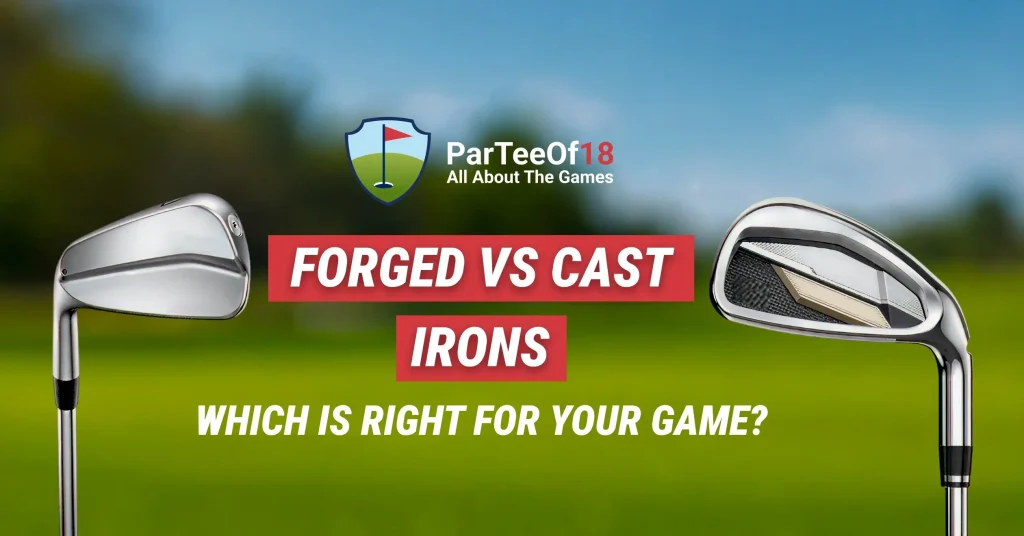
“Forged irons are for better players. Cast irons are for beginners.” It’s a common belief; but only a part of the story. The truth is, the forged vs cast irons debate is far more nuanced than most golfers think, and choosing the wrong set could be affecting your performance more than you realize. If you are trying to choose the right set for your game, understanding how forged and cast designs actually perform is the key to making a smarter decision.
What are Forged Irons?
Forged irons are a type of golf club that is made by heating and shaping a solid, single piece of metal, usually soft carbon steel, under intense pressure. They are known for providing a dense, soft, and highly responsive feel, with a thinner topline and narrower soles which is generally considered to be of superior quality. Forged irons are also recognized for having a compact clubhead shape and traditional look, and they are considered superior for providing greater control, accuracy, and workability.
What are Cast Irons?
Cast irons are a type of golf club that is made by pouring molten metal into a mold to form the clubhead, allowing for a variety of designs that help enhance performance. This makes cast irons durable, cost-effective, and suitable for making clubs with perimeter weighting, which gives the clubs a high-launch performance, making them suitable for beginners and high-handicap players due to the improvement in the performance of the clubs.
Key Differences Between Forged vs Cast Irons
While both forged vs cast irons can play exceptionally well, the real difference comes down to how they feel, how they’re made, and how they play on the course. The more you understand these differences, the easier it becomes to choose the right type of golf iron for your swing, skill level, and overall game.
Manufacturing Process
The main difference in the process of making forged irons vs cast irons lies in the process of shaping the metal used in making these irons. In forged irons, the metal used is hammered into the desired form, while in cast irons, the metal used is in a molten state when poured into a mold. This is what gives forged irons their denser feel and greater responsiveness at impact.
Ball Flight and Distance Control
Forged irons focus on providing workability, a soft feel, and distance control for skilled ball strikers, while cast irons provide greater forgiveness, better ball speeds, and distance control on off-center hits. In forged irons, shaping can be easily done, i.e., draws and fades, while in cast irons, perimeter weighting is used for performance.
Weight Distribution and Stability
As forged irons are typically more centralized in their weighting, and cast irons are known for their greater weighting around the perimeter, it is understandable that this is not necessarily so in modern irons. However, forgiveness and stability in modern golf are not necessarily dependent on whether an iron is forged or cast, but more so on the overall design of the clubhead itself.
MOI
Cast irons have greater MOI, which means greater forgiveness, while forged irons have lesser MOI, which means lesser forgiveness but greater workability. However, the modern forged cavity-back designs now offer high MOI levels that rival cast clubs.
Forgiveness
Cast irons are more forgiving, making them suitable for beginners and mid-high handicappers, while forged irons are more precise, making them suitable for better players who require greater accuracy but less forgiveness.
Feel And Feedback
Forged irons provide the softer, more malleable, or buttery feel, along with precise, detailed feedback regarding the quality of the shot, which is suited for better golfers, whereas cast irons provide the firmer, more muted feel with greater and easier-to-hit forgiveness, making them suited for high-handicappers. Forged golf clubs, made of solid steel, are best for feedback.
Cost
Forged irons are more expensive than cast irons because of their more labor-intensive and time-consuming manufacturing requirements, which need more skilled labor and equipment, while cast irons are more affordable because of their faster manufacturing time, which requires less labor.
Customization
Forged irons are better for customization because of the softer, more flexible material which can be easily adjusted for loft and lie. Although cast irons are constructed from harder alloys for strength and detail within the mold, and are not as easily bendable without risking damage, forged irons are better for custom fittings.
Pros and Cons of Forged and Cast Irons
When it comes to forged vs cast irons, the best option for you depends on what you are looking for in a club. Some golfers may be looking for a better feel, while others may need more forgiveness in their game, especially if you are trying to determine the best golf club for beginners. It is helpful to understand where each type excels and where it may struggle.
Pros of Forged Irons
- Softer feel and better feedback to know exactly where on the face the ball is making contact.
- Best for golfers who want to be able to shape their shots and can use fades and draws to their advantage.
- Compact design and thinner profile allow for that clean and classic look that better golfers desire.
- Easier to adjust loft and lie on forged irons to get that custom fit dialed in.
Cons of Forged Irons
- Off-center strikes tend to lose more distance and accuracy because most forged models are less forgiving.
- Softer metal can pick up bag chatter and surface marks more quickly over time.
- Not always the easiest option for newer or improving golfers who need extra help on mishits.
Pros of Cast Irons
- More forgiving across the face, helping maintain speed and direction when contact isn’t perfect.
- Launch the ball high and allow for easy carry distance to be achieved.
- Allow for more advanced designs to be made on the club head, giving manufacturers room to add game improvement features.
- Cast iron clubs are generally less expensive to purchase.
Cons of Cast Irons
- Firm striking and doesn’t offer the same level of feedback that forged clubs offer.
- Larger club heads, thicker profiles, and wider soles don’t offer that clean and compact look that many golfers desire.
- Loft and lie can be harder to adjust on cast iron clubs, depending on the construction and material.
What are Combo or “forged-cast” Irons?
Combo or “Forged-Cast” irons represent a hybrid golf club that features a soft-forged face insert that provides greater feedback and feel during impact, as well as a cast body that is able to provide greater perimeter weighting and forgiveness. This represents the ultimate combination of two different worlds: the feedback of forged iron during contact, combined with the forgiveness of cast iron.
Note: “Forged-Cast” refers to this particular single-club hybrid iron combination; it is not to be confused with a “Combo Set,” which refers to an entire set of golf clubs combining two different types of iron designs, such as cast long irons and forged short irons, in order to provide varying levels of performance throughout the bag.
Should You Get Cast or Forged Iron?
If you’re a low handicapper or scratch golfer who values shot shaping, feel, and precision, forged is your answer. If you’re a beginner, high-, or mid-handicapper who wants consistency, forgiveness, and easier distance, cast irons will serve your game better. And if you fall somewhere in the middle, a forged-cast hybrid gives you both without compromise.
It comes down to your swing, your skill level, and what you want to feel at impact. The best iron is simply the one that gives you more confidence over the ball and more consistency on the course.
Now that you know which iron suits your game, the next step is tracking whether it’s actually working. This is where a golf scoring app naturally fits in; position it as a tool to validate their equipment choice through real round data, not as a random recommendation.
Start Your Smarter Golf Journey Today!


FAQs
Are Forged Better Than Cast Irons?
Forged irons are not better than cast irons but have a different, softer feel and are easier to work with, which are advantages to low handicap players. Cast irons are better in forgiveness, durability, and cost-effectiveness, which are advantages for beginners and intermediate players.
Do Forged Irons Go Further Than Cast Irons?
No, forged irons do not go further than cast irons. In fact, cast irons may go further and faster than forged irons due to features such as strong lofts and extreme perimeter weighting.
Which is harder to maintain?
Forged irons may be harder to maintain than cast irons. Although they may look similar in terms of cleaning, forged irons may be softer than cast irons and therefore more likely to get dings and scratches, thus requiring more care and maintenance, including headcovers.
Which Type of Iron Is Best for You?
Forged irons are best suited for the best players or low handicap players, and they emphasize feel, feedback, and workability, while cast irons are best suited for beginners and mid-handicap golfers, who need maximum forgiveness and distance.
Do Forged Irons Last Longer Than Cast Irons?
No, forged irons may not necessarily last longer than cast irons. In fact, forged irons may not last longer than cast irons because they may be softer than cast irons and therefore more likely to get dings and scratches and wear out faster than cast irons, which may be harder and more durable.