A ball stops 18 inches from the cup, and suddenly the debate starts; tap it in, or just pick it up? That little moment has sparked more arguments, side-eyes, and clubhouse opinions than most full rounds ever do. That’s the strange beauty of gimme in golf. It feels harmless in a casual game, but it can get surprisingly serious once money, pride, or rules enter the picture. So, what is a gimme in golf, really? Is it just a friendly shortcut, or does it cross a line? Here’s what every golfer should know before casually saying, “That’s good.”
What Is a Gimme in Golf?
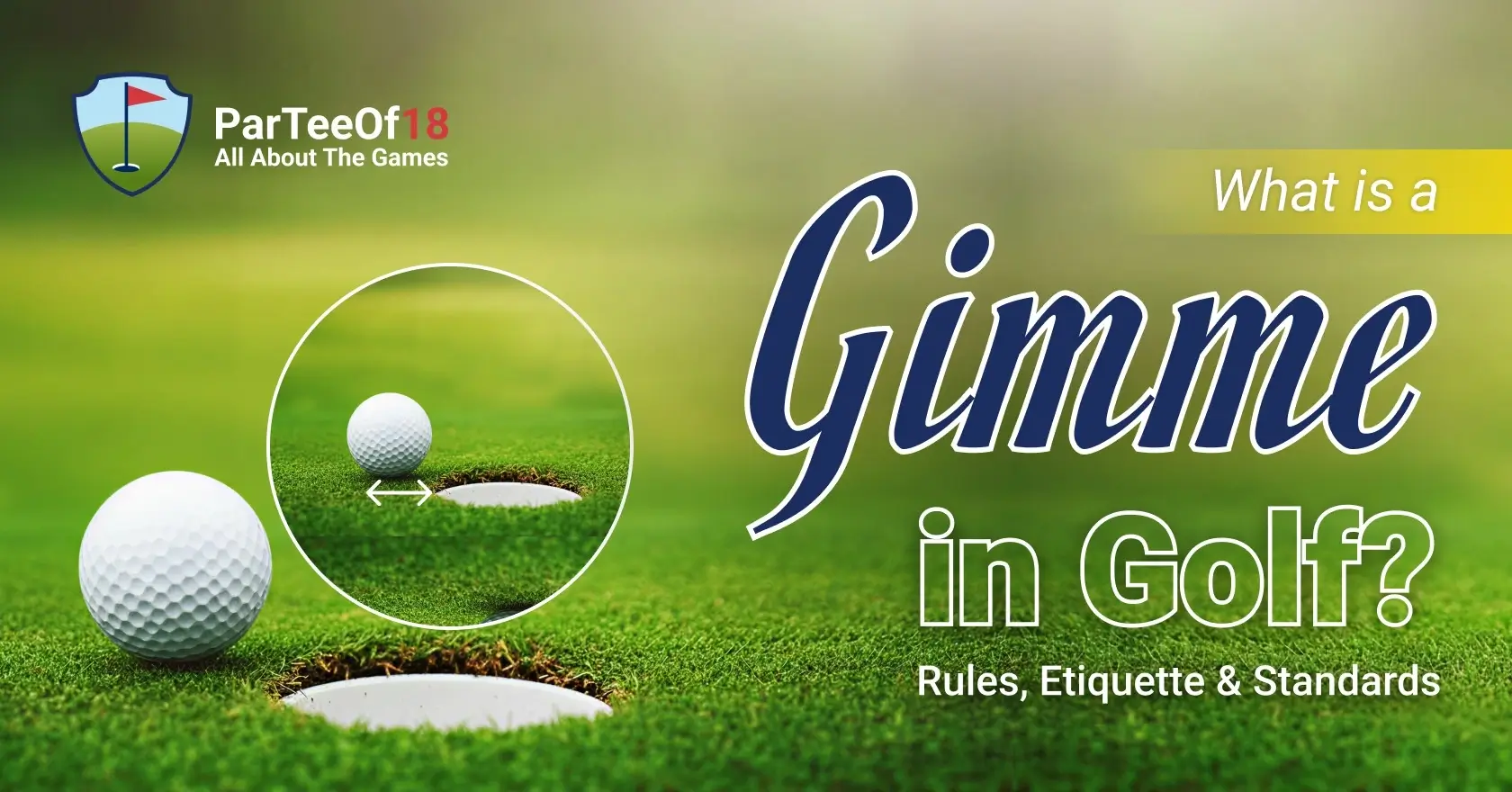
A gimme in golf is a very short putt, usually less than 1 to 2 feet from the hole, or “inside the leather” of the putter grip. Playing partners or opponents agree to count it as holed without the player actually putting it as it is almost certain to go in. The player picks up the ball and adds one stroke to their score. Gimmies are often used in casual rounds to speed up play, but they aren’t allowed in formal stroke play competitions that follow the Rules of Golf. The Golf term gimme comes from “give me,” as in, will you give me that putt? It started as casual course slang and just stuck.
How Short is a Gimme Putt?
A gimme putt is usually considered to be within 1-2 feet of the hole, which is often measured informally as inside the leather, which is the distance from the putter head to the start of grip (<0.6 meters). While there aren’t any official rules for them in casual play, they are meant to speed up play on short putts that are rare to miss.
A good rule of thumb is this: if a beginner would feel embarrassed missing it, it is probably a gimme. Tour pros make around 92% of putts from three feet, so even they are not automatic from there. For an average golfer shooting in the 90s, that make percentage drops closer to 55%. Keep that in mind before assuming any putt is a tap-in.
Are Gimmes Allowed in Official Tournaments?
In official stroke play tournaments, players are not allowed to say gimme, which is short for “give me,” but on the contrary, they are allowed in match play, where it is referred to as “conceded putts.” Every ball must be holed out in any tournament or round played according to the official Rules of Golf. This includes club championships, stableford (a scoring system in golf), medal play, and rounds that are meant to be used for handicap purposes. In other words, the ball has to actually go into the cup.
One grey area is society days and charity events. A lot of groups hand out gimmes freely in these formats without realizing that if other groups in the same competition are putting everything out, the field is effectively playing by different rules. The safe habit is always to hole out unless the format explicitly says otherwise.
Why Do We Need Golf Gimmies?
Gimme in golf is a common feature in casual rounds and is intended to ensure that the game is played smoothly. Although gimmies are not allowed during official tournaments, some golfers include them in casual games for ease and efficiency. Here are some reasons why golfers use gimmies during their games.
Pace of Play: The biggest reason for gimmes is to speed up the pace of play by eliminating the time spent marking, lining up, and executing very short putts.
Casual Courtesy: In casual games, giving a short putt is a courtesy to allow for a social experience and avoid embarrassment over a possible miss.
Match Play Strategy: In formal match play, an opponent may concede a putt to speed up play or to force a player to pick up, so that they do not know the line on a future putt.
Physical Comfort: For old players or on difficult greens, not having to constantly bend over for 6-inch putts makes the game more comfortable to play.
The Do’s and Don’ts of Gimme Putt Etiquette
Knowing the basic do’s and don’ts of gimme putt etiquette helps keep the round fair, friendly, and free of extra confusion.
Dos of Gimme Putt Etiquette
- Use gimmes to keep the round moving, especially when the putt is a true tap-in and everyone knows it’s not changing anything.
- Say it clearly before the player picks up the ball so there’s no awkward “was that good or not?” moment.
- Be consistent with what you’re giving throughout the round, so nobody feels like the rules are changing hole to hole.
- Save gimmes for casual rounds or friendly matches where the goal is pace and fun, not strict scorekeeping.
- Think about the situation before giving one; a one-footer for double bogey is very different from a short putt for birdie.
- Let the format guide the decision; in match play, concessions are part of the game; in stroke play, holing out is usually the cleaner habit.
- Use good judgment with new golfers since a small concession can help confidence without slowing everyone down.
Don’ts of Gimme Putt Etiquette
- Assume every short putt is a gimme; until someone gives it, the ball is still in play.
- Pick the ball up early unless the putt has clearly been conceded. That’s one of the fastest ways to create confusion.
- Ask for gimmes on every close putt because it starts to feel forced, and nobody likes that.
- Hand out gimmies in big moments too easily if the putt actually matters to the hole, the match, or the score.
- Change your standards halfway through the round just because the pressure goes up. That can feel unfair fast.
- Get irritated if someone wants you to finish the putt; sometimes they’re protecting the competition, not being difficult.
- Use gimmes in tournaments or handicap rounds where every stroke needs to count properly.
- Turn a friendly gesture into gamesmanship by giving some putts and denying nearly identical ones later.
Note: If you’re just playing for fun, a gimme is fine. But if you’re playing for money, in a competition, or keeping track of your handicap, you should putt everything out.
Precise Handicap Tracking with Pro-level Analytics.


Gimme Putts vs Conceded Putts: What’s the Difference?
Many golfers treat gimmes and conceded putts like they mean the same thing, but they really don’t. A conceded putt is an actual rule in match play. If your opponent gives you the putt, it counts as holed; there’s no need to tap it in. It’s completely official and allowed under the rules.
A gimme in golf, though, is different. That’s more of a casual golf thing. In a friendly stroke play round, players might agree to give each other those short putts just to keep things moving. It constantly happens, but technically, it’s not part of the Rules of Golf.
Famous “Gimme” Moments in Golf History
Gimme moments in golf are some of the instances where a putt is conceded, or conversely, a short putt is missed. This is where golfers created some of the most dramatic and sportsmanlike moments in sports history.
Here are the most famous gimme moments in golf history:
1969 Ryder Cup: Jack Nicklaus and Tony Jacklin
The most famous gimme moment in golf history came at Royal Birkdale in the 1969 Ryder Cup. On the 18th hole, with the overall match tied, Jack Nicklaus conceded Tony Jacklin’s 2½- to 3-foot putt, creating the first tie in Ryder Cup history (16–16). The moment became legendary as The Concession.
2015 Solheim Cup: Alison Lee and Suzann Pettersen
One of golf’s biggest concession controversies happened at the 2015 Solheim Cup, which is also often called gimmegate. On the 17th green, Alison Lee picked up a short putt of about 2 feet, believing it had been conceded by Suzann Pettersen and Charley Hull. Pettersen said it had not been given, Europe was awarded the hole, and the incident sparked a major uproar before the U.S. rallied to win 14½–13½.
1985 Ryder Cup: Craig Stadler
At the 1985 Ryder Cup, Craig Stadler missed a painfully short 14-inch putt on Day 2, turning what could have been a U.S. win into a halved match. It was the kind of tiny miss that felt enormous, and it helped swing momentum toward Europe in a week that ended with their first Ryder Cup win in 28 years.
1946 Masters: Ben Hogan
Even the all-time greats sometimes miss the ones they should never miss. At the 1946 Masters, Ben Hogan reached the 72nd hole needing a par to force a playoff with Herman Keiser. After missing his birdie try, he missed the comeback 2-foot par putt, handing Keiser the Green Jacket.
1970 Open Championship: Doug Sander
Few missed short putts are more famous than Doug Sanders’ at St. Andrews in the 1970 Open Championship. On the 72nd hole, Sanders missed a 3-foot par putt that would have won him the title outright. Instead, he went to an 18-hole playoff, where Jack Nicklaus beat him 72–73. Brutal. Historic. Unforgettable.
Conclusion
In recreational golf, a gimme can speed up play and make the game more fun. But it shouldn’t be used in tournaments or other places where the Rules of Golf are in effect. You need to know the difference between convenience and compliance in gimme golf. This agreement can be helpful in casual games but destructive in competitive ones.
FAQs
Are gimmes allowed in the Ryder Cup?
Yes, “gimmes,” which are also called concessions, are allowed and very common in the Ryder Cup because it is a match play tournament. To speed up the game and because it’s unlikely that they’ll miss, opponents often give up short putts, usually within 1–2 feet, so players can pick up their balls.
Can you withdraw a gimme in golf?
No, you can’t take it back, refuse it, or withdraw it once your opponent offers you a gimme (conceded putt) in match play. The hole is officially over, and the stroke is counted once the concession is made.
Does a gimme count as a stroke?
Yes, a “gimme” (a conceded putt) definitely counts as a stroke on your scorecard. Even though the stroke doesn’t actually hit the hole, it is added to your total as a one-stroke courtesy to speed up play. In casual play, they are usually okay, but not in formal stroke-play tournaments.
Can You Ask for a Gimme in Golf?
You can, but it is considered bad etiquette. A gimme is meant to be offered by your opponent, not requested. If nobody says anything, putt it out. Asking for one puts the other player in an awkward spot and most golfers remember it. Wait for it to be given, not grabbed.
Are Gimmes Allowed in Handicap Rounds?
No. Under the World Handicap System, every hole must be completed properly under the Rules of Golf for your score to count. If you pick up a short putt without holing it, that hole is incomplete. For a general play score to be valid, at least 10 holes must be finished correctly. Putt everything out when your handicap is on the line.
What Does “Inside the Leather” Mean in Golf?
It means your ball is closer to the hole than the length of your putter grip, roughly 10 to 12 inches. If the ball sits inside that distance, it is generally considered a fair gimme in casual play. The phrase comes from old putters with leather-wrapped grips. It is informal, not an official rule, so agree on the standard before the round starts.
What Is the Difference Between a Gimme and a Conceded Putt?
A conceded putt is an official act under the Rules of Golf, allowed in match play only. A gimme is an informal agreement between players in casual rounds and has no place in the official rulebook. Both result in picking up the ball without putting, but one is legal in competition and one is not.




 3D Green Maps
 Handicap Lookup
 Live
Scorecard & Leaderboard
Live
Scorecard & Leaderboard Digital
Wallet
Digital
Wallet Randomizer