 Golf Tips & Education
 MacKenzie Tyler
 May 26, 2026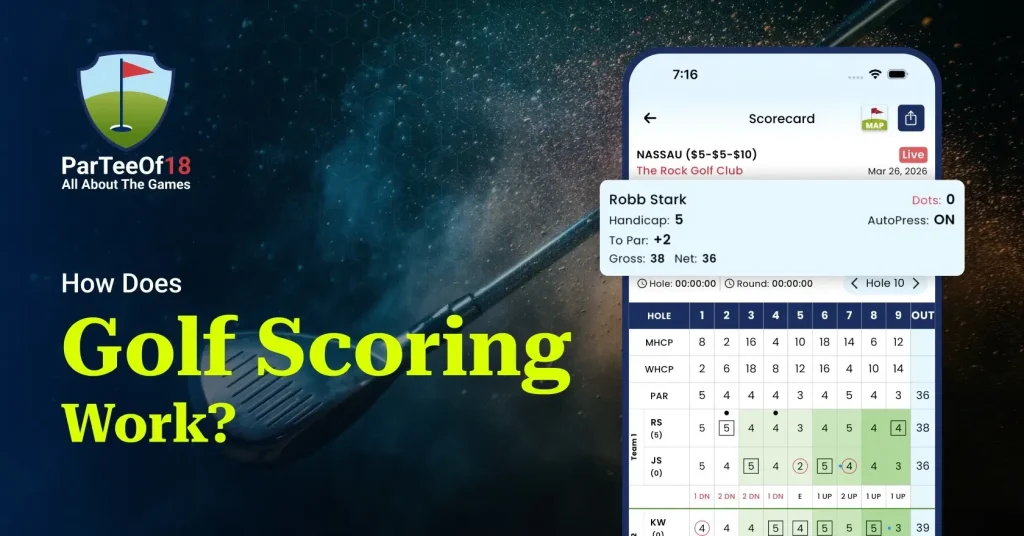
 Last Updated: July 10, 2026


Ever watched a golf match and wondered why players celebrate finishing with the lowest number? If you’re new to the game, wondering how does golf scoring work is completely normal, and the answer is simpler than you’d expect.
From counting strokes to knowing what “par” really means, learning the basics of golf scoring enables you to enjoy the game more whether you’re playing or just watching with friends. This blog will walk you through how does golf scoring work, what common golf terms mean & how to easily understand a golf scorecard.
The Basic Idea: You’re Counting Strokes
Golf scoring is simple once you understand the basics. Every time you swing at the ball with the intention to hit it, that counts as one stroke. You count all your strokes on each hole, then add them together after playing all 18 holes. Your final score is compared to something which is called par. It is the number of strokes a good golfer is expected to take on the course. The main thing to remember is that, unlike many other sports, a lower score in golf is always better.
At the end of 18 holes, your total stroke count is measured against the course par. Most standard courses play to a par of 72, so if you finish with 80 strokes, your score for the round is 8 over par. Shoot 68 on that same course and you are 4 under par. This is how golf scoring works on a leaderboard, whether you are watching a Sunday broadcast or checking your golf app after a weekend round.
How to Keep Score in Golf: Hole by Hole
Keeping score in golf is straightforward once you know what to track. Start counting from your very first swing on the tee. Every stroke on that hole adds one to your count. Add any penalty strokes as they happen, not at the end of the hole. When the ball drops into the cup, that final putt is your last stroke. Write the total in the box for that hole on the scorecard immediately, then start fresh on the next hole.
At the end of nine holes, add up your front nine total in the subtotal box. Do the same after 18. That final number is your gross score for the round. If you lose count mid-hole, ask your playing partner. In competitive rounds, golfers keep each other’s scores for exactly this reason. In casual play, agree on a reasonable number and move on. The important thing is that every hole gets a number in the box before you move to the next tee.
Golf Scoring Terms: What Each Result Is Called
Below is a short guide to the most frequently used golf scoring terminology that will pop up while playing or viewing the leaderboards:
Birdie – A term used when a player scores one under par, e.g., he scores 3 on a par-4 hole.
Eagle – A golfer makes an eagle when he gets done with a hole 2 strokes less than par. For example, his score is 3 on a par-5 hole.
Albatross (Double Eagle) – An extremely rare type of score when a player finishes a hole 3 strokes under par.
Par – The standard number of strokes needed to get through a hole.
Bogey – This term is used when a player gets done with a hole 1 stroke over par, e.g., scores 5 in a par-4 hole.
Double Bogey – Scoring 2 strokes over par.
Triple Bogey – Completing a hole 3 strokes over par.
Condor – An extremely rare score of 4 strokes under par on a single hole.
How Your Handicap Affects Your Score
Not everyone who plays golf is a scratch golfer, and that’s the whole point of a golf handicap. A handicap is a numerical measure of a player’s skill level that allows golfers of different abilities to compete fairly against each other.
When you apply your handicap to your total strokes, the result is called your net score. In golf, gross vs net score is the key distinction: your gross score is what you actually shot, and your net score is what you shot after your handicap strokes are subtracted. So if you shot 90 on a course with a par of 72, and your handicap is 18, your net score would be 72; which is right at par. This is what makes golf uniquely inclusive: a beginner and a low-handicapper can have a genuinely competitive round together.
You May Also Checkout: Handicap Index vs Handicap: What’s the Difference and Why It Matters.
Popular Golf Scoring Formats
Understanding how does golf scoring work also means knowing that some situations add strokes to your score that have nothing to do with actually hitting the ball well. Not every round of golf is scored the same way. Depending on who you’re playing with and what golf format is being used, the rules for counting your score can change quite a bit. Here are the four most common formats you’ll encounter.
Stroke Play
Stroke play is one of the most straightforward golf scoring formats. Also, it is the one most people think of when they imagine competitive golf. Every stroke on every hole counts, and your total for the round is your score. The player with the lowest total strokes at the end of 18 holes wins. This is the format used in most professional tournaments, including all four golf major tournaments.
If two players finish with the same total strokes, most competitions go to a sudden-death playoff where they continue playing hole by hole until one player outscores the other on a single hole.
Match Play
In match play golf scoring format, you’re not counting total strokes across the round; instead, you compete hole by hole. Win a hole (finish it in fewer strokes than your opponent), and you win that hole. The player who wins the most holes wins the match. You can win a match without completing all 18 holes if your lead becomes mathematically insurmountable; for example, being “4 up with 3 to play” means you’ve already won. Match play is common in team competitions & events like the Ryder Cup.
If the match is level after 18 holes, play continues one hole at a time until one player wins a hole outright.
Stableford
Stableford is a points-based golf scoring format which is created to keep the round moving and prevent one bad hole from ruining your entire scorecard. Instead of counting strokes, you earn points based on how you perform relative to par on each hole. A birdie earns 3 points, a par earns 2, a bogey earns 1 & anything worse scores zero. The goal is to accumulate as many points as possible; so in Stableford, higher is better.
If two players finish level on points, most competitions resolve the tie on a countback, comparing points scored on the back nine first, then the last six holes, then the last three.
Penalty Strokes
Penalty strokes are considered as the extra strokes that are added to your score count when you break specific rules, or land in trouble. Below are some of the penalty strokes:
Out of Bounds (OB)
If your ball lands outside the marked boundaries of the course (usually indicated by white stakes), you take a one-stroke penalty & must replay the shot from the original spot. That means if your tee shot goes OB, your next shot is your third, not your second.
Water Hazards & Red/Yellow Stakes
For balls landing past red or yellow stakes, you can play it as it lies for free. If you choose to take relief, it costs one penalty stroke. You must then drop either on a backward line from the hole or within two club-lengths of the hazard entry point.
Lost Ball
A ball is officially lost if you cannot locate it within three minutes of starting your search. This infraction carries a mandatory one-stroke penalty. To proceed, you must go back to the spot of your previous shot and play a new ball from that exact location.
Unplayable Lie
You can declare your ball unplayable anywhere on the course except inside a penalty area. Taking a one-stroke penalty gives you three choices. You can drop within two club-lengths, back away on a straight line from the hole, or replay your previous shot from its original location.
Understanding penalties is a key part of knowing how do you score in golf accurately; every stroke, including penalty strokes, goes into your total. That’s the core of how you score in golf, count everything, including the mistakes, and the lowest honest total wins.
How to Read a Golf Scorecard
Every golf course gives you a scorecard when you play, and understanding how to interpret it makes your round a lot smoother. A typical scorecard shows each hole number, its par value, the yardage from various tees, the stroke index (used for handicap play), and space to write down your scores. There is quite a bit to unpack, from what the stroke index column actually means to how to fill in your net score correctly.
To help you make sense of it all, we have put together a dedicated guide on how to read a golf scorecard that walks you through every column, number, and abbreviation so you know exactly how to score a golf scorecard hole by hole.
Common Golf Scoring Mistakes to Avoid
Even once you understand how golf scoring works, a few mistakes come up again and again, especially for newer players.
Forgetting penalty strokes. A ball hit out of bounds, into a water hazard, or lost in the rough all carry penalty strokes that must be added before you play your next shot. They are not optional, and they are not separate from your score. Every penalty goes into your hole total.
Counting a whiff as a practice swing. If you swing at the ball with the intention of hitting it and miss, that is a stroke. It counts. The only swings that do not count are deliberate practice swings where you are not attempting to strike the ball.
Not writing the score down immediately. Two holes later, you will not remember whether you made a 5 or a 6 on hole 4. Write it down as soon as you hole out, every single time.
Signing an incorrect scorecard in competition. In stroke play, if you sign and submit a scorecard showing a score lower than what you actually shot, you are disqualified. Not penalized, disqualified. If the recorded score is higher than actual, that higher score stands. Always check your card before you sign it.
12+ formats. One scorecard app. Download free.


FAQs
What is a birdie in golf?
A birdie means you finished a hole in one stroke fewer than par. On a par 4, that means getting the ball in the hole in 3 shots. It’s one of the most satisfying results in the game, and even experienced golfers celebrate them.
What is the difference between gross and net score in golf?
Your gross score is your raw total; every stroke you took across the round, added up with no adjustments. Your net score is your gross score minus your handicap allowance. Net scoring is what allows golfers at different skill levels to compete on a fair footing. You can read the complete guide here.
What happens if you hit out of bounds in golf?
One stroke is added to your score, and you must retake the shot from where you took it initially. Because you’ve now used the original shot and a penalty stroke, heading out of bounds effectively costs you two strokes in total. It’s one of the game’s tougher penalties, which is why playing conservatively away from OB markers is usually the smarter call.
What is the difference between stroke play and match play?
Stroke play is when you consider all the strokes in the 18 holes played to determine the winner. While, match play considers each hole individually. In match play, you compete on a hole-by-hole basis; the player who wins more holes than their opponent wins the match, regardless of total stroke count. Checkout complete guide here : Stroke Play vs Match Play.
Is a lower score better in golf?
Yes. In traditional golf scoring, a lower score is better. The aim is to complete the course with the fewest strokes possible. However, there are some situations in which scoring is done through the Stableford scoring system, where a high point score is indicative of good performance.
What does “E” mean on a golf leaderboard?
The “E” refers to Even which means the player is sitting at exactly par, neither above nor below it. In case someone completes 18 holes and ends up with a score equal to the par of the golf course, then they will appear as “E” (even par).
How many strokes is par for 18 holes?
Most standard 18-hole courses are set at a total par of 72, though it can differ anywhere from 70 to 75 which depends on the layout & difficulty of the course. That total is made up of a combination of par 3, par 4, and par 5 holes.
Do you need a handicap to play golf?
No, you don’t need a handicap to enjoy a casual round. But in case you want to play in official competitions, or track your improvement over time, getting an official handicap via your national golf association is a good idea. It also makes the game a lot more fun when competing with players of different skill levels, since everyone’s working from a fair net score.
How does the golf scoring system work?
Golf uses a stroke-based scoring system where every swing counts as one stroke. Each hole has a par value which the number of strokes a skilled golfer is expected to need, and your score on that hole is recorded relative to par. Your total score across all 18 holes determines your result. In most formats, the lowest score wins.
How do I keep score in golf?
Count every stroke you take on each hole, including any penalty strokes, and write that number on your scorecard. At the end of the round, add up all 18 holes. That total is your gross score. If you’re playing with a handicap, subtract your handicap strokes from the gross total to get your net score.
All Premium Features Unlocked
No catch. Cancel anytime




MacKenzie Tyler is a competitive golfer preparing to turn professional on the LPGA Tour. A former All-League golfer and three-sport athlete, Tyler spent nine seasons caddying at Sebonack Golf Club on Long Island, where she developed a thorough understanding of the game. In 2025, she won the Long Island Amateur at -4 over 36 holes, qualified for the U.S. Mid-Amateur, and became the first alternate at her U.S. Women's Open qualifying site after leading the field through round one.


Related Posts

9 Fun Golf Putting Games to Play (Practice Green and On the Course)
Discover fun golf putting games for the practice green and real rounds, plus the drills that back them up and...

What Is a Chip Shot in Golf? How to Hit It and When to Use It
Learn what a chip shot is, when to chip vs. pitch vs. putt, and how to hit it clean. Simple...

What Is Lag Putting? (And the 3 Drills That Actually Fix It)
Learn what lag putting means, why distance control matters, and three practical drills to help reduce three-putts and improve your...
What Is PCC in Golf? Playing Conditions Calculation Explained
PCC is the daily adjustment that corrects your score differential when a course plays easier or harder than its rating....